From WROG to WQRI: 50 Years of Student Radio at Roger Williams
What began with a student-written charter, borrowed equipment, and a closed-circuit signal running through campus phone lines has grown into WQRI 88.3 FM, a station shaped, rebuilt, and carried forward by generations of Hawks at Roger Williams University.
BRISTOL, R.I. — Long before anyone at Roger Williams could tune in to WQRI on 88.3 FM or stream it online, student radio traveled through wires.
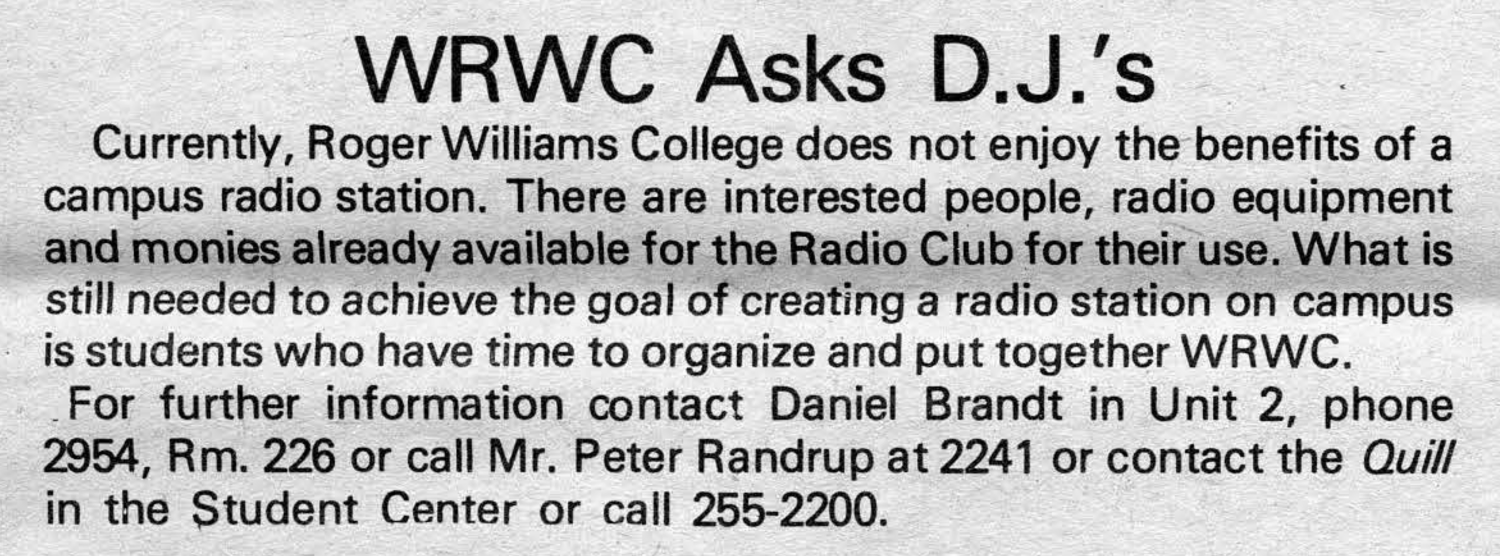
In 1976, Roger Williams College students communicated through bulletin boards, flyers taped to dormitory doors, campus mailboxes, and The Quill. There had been interest in establishing a radio station — and even previous attempts — but no lasting station existed. A September 29, 1976, Quill notice put it plainly: the college had interested people, equipment, and money available. What it still needed were students willing to organize it.
Matt Egan ’78 was one of the students who took up that challenge.
A junior Accounting major, resident assistant, and Student Senate member, Egan took an existing radio club and began assembling the pieces necessary to make it something more. He wrote a charter. He went to Student Senate for funding. He recruited students. He secured space in the basement of Dorm II. With guidance from Marketing Professor Peter Randrup and support from students including Bob Pullman and Richard Heidelman, the group pieced together equipment and learned how to make a station work.
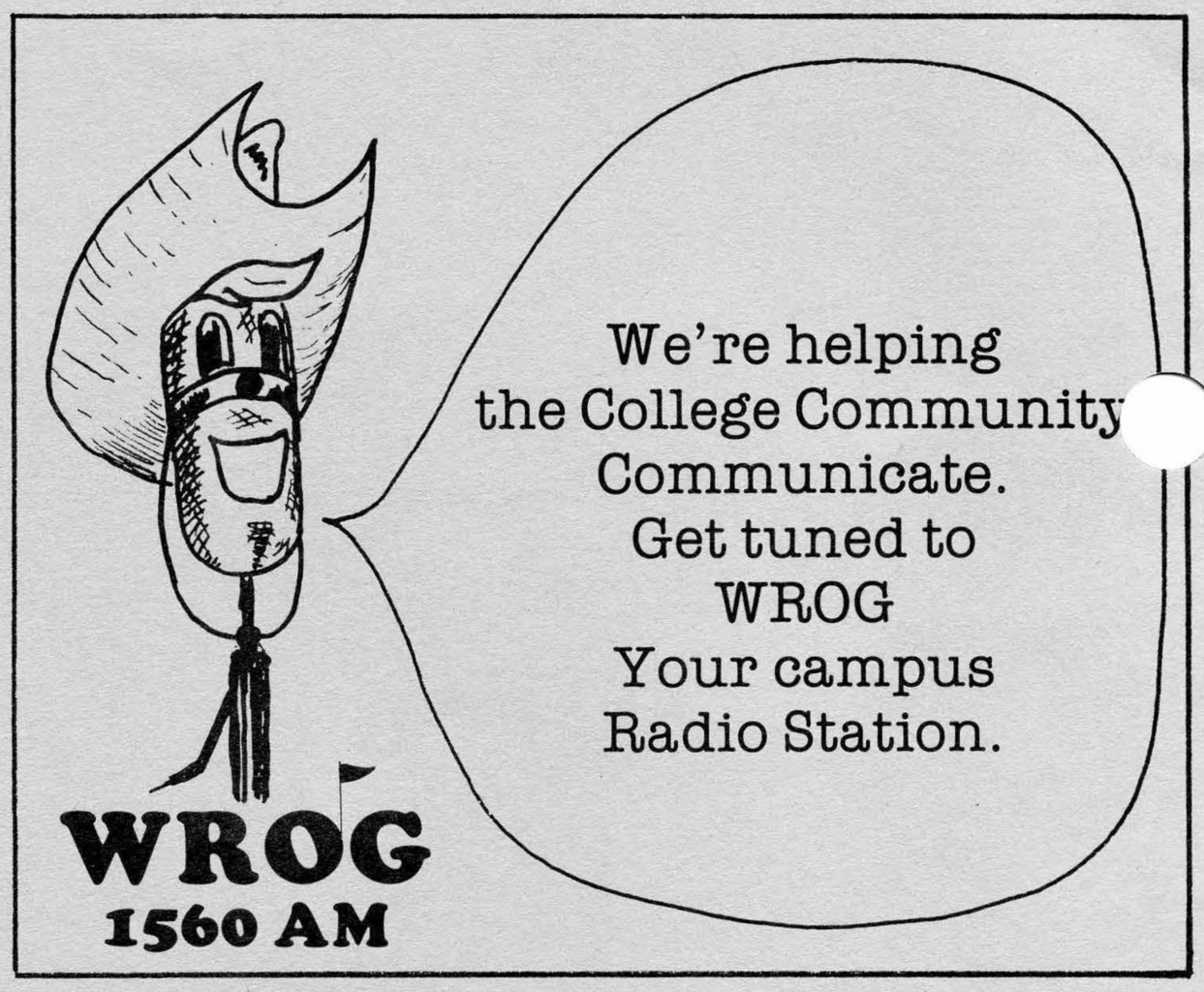
The technical solution was appropriately homemade. WROG's signal was sent from the station through the campus telephone system, amplified along the way, and fed into buildings around campus. Broadcasting on 1560 AM, it was a carrier-current operation: its audience was essentially Roger Williams itself. Egan remembers the group occupying its new space in fall 1976 and reaching the air by the following semester.
That limitation became part of what made WROG distinctive. Students played records, took requests, shared campus news, and talked about the people and events their listeners knew firsthand. By the time the station began broadcasting, Egan recalled, more than a dozen students were already waiting for their chance behind the microphone.
For Egan, building WROG became far more than another extracurricular activity. The work required students to organize people, solve technical problems, raise money, manage limited resources, and create something that had not existed before.
“It was the best education I ever had,” Egan said of the experience, pointing to the lessons he learned in planning, organization, execution, and working with people.
Fifty years later, that may be the most consistent thread running through the history of WROG and WQRI.
The equipment changed. The rooms changed. Vinyl gave way to CDs, automation systems, and digital libraries. A signal that once traveled through campus wiring eventually reached communities across state lines — and then, through the internet, listeners virtually anywhere.
But each version of the station has given students something that a classroom alone cannot: something real to operate, experiment with, and eventually hand to someone else.
Always Building the Next Station
WROG did not remain the station Egan created for long.
By 1981, another generation had rebuilt its studios, strengthened training requirements, added a news operation, established more consistent hours, and adopted a more structured programming philosophy. The station remained on 1560 AM, largely confined to campus, but its leaders were already openly talking about a goal that would define much of the next decade: FM.
The push became formal in 1982. Under General Manager Todd Reiss and Chief Engineer Richard Hecklemann, WROG completed an extensive application to become an educational FM station. President William Rizzini approved the proposal before it went to the Federal Communications Commission. Even then, students were warned that approval could take anywhere from months to years.
It took years.
Applications stalled. Federal rules changed. Technical concerns involving television frequencies complicated the process. Students needed new equipment, an antenna, engineering expertise, funding, and eventually a new call sign because WROG was unavailable for the licensed FM operation. Through leadership changes and graduations, the pursuit continued. By 1986, WROG could be heard on 88.3 FM at low power on and immediately around campus, but the long-sought 100-watt operation remained unfinished.
The first newspaper reference found in the archival record to the station as WQRI appears in November 1987. The following year brought the construction permit, but also another round of delays involving the tower, equipment, construction, engineering, and money. The tower alone, initially expected to cost between $5,000 and $6,000, ultimately came in at approximately $17,000.
Then came March 9, 1989.
“WQRI FM Bristol” opened its broadcasting day that Thursday morning on 88.3 FM at 100 watts. Advisor Tony Ferreira called from Warwick to report that the signal was coming in “loud and clear.” The morning team of Ron Olf, Gordon Kent ’91, Dawn Glenney, and Sotiri Barbounis mixed news, sports, conversation, comedy, and music as a station once restricted to campus announced itself across Bristol County and into southeastern Massachusetts.
It had taken more than a decade of students advancing an idea many of them would graduate before seeing completed.
Egan remembers Randrup telling him something similar at the very beginning: it might not happen “on your watch.” Move it as far as you can, he told him, and the next person will carry it farther.
That is exactly what happened.
Beyond the College
Going to 100 watts changed more than WQRI's range. It changed how students imagined the station.
By spring 1989, WQRI had a professional-quality studio, a staff of 55 students, and programming that ran about 20 hours a day. Its leaders increasingly viewed the station as a working laboratory for broadcasting — a place to learn not only how to speak into a microphone, but how programming, production, news, promotions, management, and audience development fit together.
Olf and fellow station leaders developed relationships with commercial broadcasters. WQRI added computerized music and underwriting scheduling and an Associated Press news wire. DJs received feedback on their airchecks. Live remote broadcasts took the station into Bristol businesses and events. Community members filled difficult overnight, weekend, holiday, and summer shifts, helping WQRI maintain programming when students left campus.
The station also developed relationships with record companies, promoters, artists, and other broadcasters. Community volunteer Bruce Cunard remembers an operation whose 100-watt signal belied its ambition, opening doors to internships and connections with artists including Anthrax, Queensrÿche, and Bruce Dickinson.
Kent, who entered WQRI as a freshman DJ in 1987 and eventually became general manager, remembers those years as a period when students increasingly treated the station as a real-world educational enterprise. Journalism, production, promotions, technology, budgeting, management, and leadership could all be learned by doing them.
His generation, he said, wanted to build a college station that was “acknowledged and respected far beyond its wattage.”
But WQRI's outward expansion also raised a question that would surface repeatedly in different forms: Who was the station for?
By 1991, station leaders were already changing programming to reconnect WQRI with Roger Williams students after complaints that the operation had grown distant from campus. In 1992, Student Senate went further, requiring DJs and board members to be students after concerns surrounding the station's extensive use of community volunteers. With roughly half the staff affected, WQRI shut down for part of that summer and returned in the fall needing to rebuild.
What emerged was another reinvention: a station again explicitly centered on students, with broader specialty programming and a renewed emphasis on reflecting the campus it served.
It would not be the last.
New Rooms, New Ways to Be Heard
The surviving archival record grows thinner through portions of the later 1990s, but by the early 2000s another rebuilding period was underway.
In fall 2003, WQRI moved from an isolated room behind the former student dining area into a much more visible home on the second floor of the Campus Recreation Center. The booth's large window put student broadcasters in the middle of campus activity rather than behind closed doors. The station expanded its music collection, specialty shows, promotions, and ambitions for new forms of broadcasting.
Within a few years, students were thinking beyond the FM dial. In 2005, WQRI leaders were working toward internet listening, an expanded website, underwriting, an AP news source, more campus events, and new opportunities for students and faculty to get on the air.
Then, in 2006, WQRI faced one of the most consequential choices in its modern history.
Providence public-radio station WRNI proposed sharing WQRI's signal. In exchange for daytime access, the arrangement could have brought a stronger signal, greater online capacity, podcasting capabilities, engineering support, and internships. It was an attractive package — but it would also have meant surrendering WQRI's FM signal for 10 hours each weekday.
After months of debate, meetings, and a visit to WRNI, the student E-Board voted 7-3 to reject the proposal.
“It is our station and we run it,” General Manager Keri LeComte said after the decision.
The decision encapsulated another part of WQRI's history: students have inherited not just equipment and airtime, but responsibility for deciding what the station should be.
Taking Radio Outside the Booth
The next generation found new answers.
After an antenna relocation temporarily knocked WQRI off the FM air in 2008, students returned with an operation that could reach listeners both by radio and online. The technology increasingly allowed the station to leave the booth itself.
In December 2009, WQRI began broadcasting select Hawks men's and women's basketball games live. Program Director Tucker Silva ’10 had pushed for the project, and a new remote unit allowed students to transmit play-by-play from the gym. It provided a service for Hawks fans while creating a new laboratory for students interested in sports media.
Silva and classmates including Tim McKone ’10 gained the kind of live repetitions that could not be simulated in a classroom. McKone, now a full-time voice on Boston sports radio, remembers WQRI as a place to learn preparation, pacing, research, and comfort behind a live microphone.
The same remote technology soon took WQRI off campus. In January 2010, a broadcast from a Bristol venue raised $900 for Haiti earthquake relief, demonstrating that remote broadcasting could also connect the station to a larger cause.
There were setbacks, too. An overheated automation system and server took WQRI off the air for nearly five months in 2010. Student Senate eventually allocated $10,000 for repairs and a new automation system, allowing the station to return to continuous programming.
Once again, keeping the station alive meant rebuilding it.
More Than What Comes Through the Speakers
By the early 2010s, WQRI's identity had expanded well beyond the broadcast booth.
Under student leaders including Matt DiPlacido ’13 and Events Director Molly Stern ’13, concerts became a major way for WQRI to reach the campus. Fall Foliage Fest featuring Badfish drew approximately 700 people in 2011. The following spring, a concert headlined by rapper Chris Webby attracted an estimated 740 to 800.
For Stern, organizing those events meant learning how to understand an audience, develop a strategy, manage budgets, work with agents, negotiate contracts, promote events, and coordinate logistics. It was another version of the same education Egan had described decades earlier: students figuring out how to turn an idea into something real.
As music consumption moved from CDs and radio toward smartphones and streaming services, WQRI continued to offer something those technologies could not: other Roger Williams students.
For some students, WQRI's influence began before they ever arrived at Roger Williams. Across generations, alumni have recalled the radio station factoring into their college decision — and, in some cases, being a specific reason they chose RWU. Tucker Silva ’10 remembers WQRI as part of what drew him to the university, while Chris Belmonte ’20 M’22 has said the opportunity to join the station played a defining role in his decision to attend Roger Williams.
Their experiences underscore something difficult to measure in watts or listenership: WQRI has not only shaped the students who joined it. At times, it has helped bring those students to Roger Williams in the first place.
Connor Linskey ’18 hosted shows throughout his four years and trained other DJs to operate the board, phones, music logs, and mobile equipment. He remembers the relationships around the station as being as important as the act of broadcasting itself. Even with nearly unlimited music available on demand, he said, hearing peers behind the microphone gave college radio a connection that a distant broadcaster or algorithm could not replicate.
By the 2017-18 academic year, the university catalog described WQRI as a student-operated, FCC-licensed station broadcasting at 650 watts, with programming spanning music, news, sports, and talk.
The medium had changed dramatically since 1976. The essential opportunity had not.
The Next Handoff
Today, WQRI remains in the Recreation Center, still operated by students and still providing a place for them to learn by doing.
In 2026, Co-General Manager Bowie Diaz ’28 described leadership at the station as coordinating programming and events, keeping the organization running, and, just as importantly, creating a place where new members feel supported and excited to participate.
That description would be recognizable to many of the people who came before her, even if the equipment around them would not be.
When Egan returned to the modern station decades after WROG began, the digital operation startled him. The walls of records were gone. Music that once had to be purchased, borrowed, donated, or mailed from record companies could now be called up from a computer.
What had not disappeared was the students.
That may explain why WROG and WQRI have endured through changing call letters, formats, studios, technologies, audiences, leadership structures, outages, and debates about what college radio ought to be.
No generation received a finished station.
The first students inherited equipment but no station. Their successors inherited AM and wanted FM. Others inherited 100 watts and sought a broader audience, inherited a community station and pulled it back toward students, inherited an isolated booth and moved it into view, inherited an FM signal and added the internet, inherited a studio and took it courtside and into the community.
Each group found something unfinished.
And then they carried it a little farther.
WROG/WQRI Through the Years
1976 | Building WROG
With Roger Williams still lacking an operating campus radio station, junior Matt Egan helps transform an existing radio club into WROG. Students secure a charter, Student Senate funding, space in Dorm II, equipment, and technical assistance. The station begins as a closed-circuit carrier-current operation, sending its 1560 AM signal through campus wiring and telephone lines.
1977 | Student Radio Reaches the Campus
Egan recalls WROG reaching the air after students spent the fall building the operation. Music, requests, campus information, and student personalities give Roger Williams a new real-time communications outlet. Within a short period, more than a dozen students become involved.
1981 | A More Structured WROG
WROG rebuilds two studios in Dorm II, strengthens DJ training, adds more consistent news and scheduling, and adopts a more defined programming strategy. The 28-member operation is still broadcasting at 1560 AM, but FM is already the long-term goal.
1982 | The Formal Push for FM
General Manager Todd Reiss and Chief Engineer Richard Hecklemann complete the extensive application needed to convert WROG from its carrier-current system to educational FM. President William Rizzini approves the proposal before it is submitted to the FCC.
1985–86 | 88.3 Arrives, But the Wait Continues
After years of FCC delays and changing federal regulations, WROG installs new equipment and begins transmitting a low-power stereo signal on 88.3 FM across campus and into parts of Bristol and Portsmouth. The station is still waiting, however, for authorization to operate at 100 watts.
1987 | WQRI Emerges
A November 1987 Messenger article contains the earliest reference found in the project archives to the station broadcasting under the WQRI name.
March 9, 1989 | 'Good Morning, Bristol County'
After years of FCC, equipment, construction, funding, and tower delays, WQRI broadcasts at 100 watts for the first time. The 88.3 FM signal reaches beyond campus through Bristol County and into southeastern Massachusetts, fundamentally changing the station's potential audience and mission.
1989–91 | WQRI Thinks Bigger
The station expands its professional-style operation with live remotes, industry mentors, community DJs, computerized music scheduling, underwriting, and increasingly structured programming. In 1991, WQRI receives an honorable mention for promotions in the National Association of College Broadcasters’ Top Station Search.
1990 | Bringing the Newsroom to WQRI
WQRI adds an Associated Press news wire, giving student broadcasters access to national and international reporting alongside campus and local news. With news updates airing throughout the day, the service becomes another part of the station’s growing emphasis on operating like a professional radio outlet.
1992 | A Student-First Reset
After years of extensive community participation, Student Senate requires station DJs and board members to be students. The change removes roughly half the staff and contributes to a summer shutdown, forcing WQRI's returning students to rebuild. The new operation expands specialty formats while reasserting that the station is “by and for” Roger Williams students.
2003–04 | Into the Recreation Center
WQRI leaves an isolated space near the former dining area and moves into a visible second-floor booth in the Campus Recreation Center. The new location, overlooking a busy student space, helps bring the station physically back into campus life.
2005 | Looking Beyond the FM Dial
Student leaders begin planning for a website capable of carrying WQRI programming over the internet, alongside new promotional efforts, underwriting, and expanded news resources. The prospect introduces an entirely new audience: listeners who do not need to live within reach of 88.3 FM.
2006–07 | Students Choose the Signal
Public broadcaster WRNI proposes using WQRI's FM frequency during weekday daytime hours in return for increased broadcast power, technical support, expanded online capabilities, and internships. After months of consideration, WQRI's student E-Board rejects the agreement 7-3, preserving continuous student control of the FM signal.
2008 | Back on the Air
Construction requires WQRI's antenna to be relocated, delaying the station's return to FM for nearly a month. WQRI resumes broadcasting Sept. 17, with its online stream now giving the station a reach far beyond its physical FM coverage.
2009 | Hawks Basketball Goes Live
Using a new remote broadcasting unit, WQRI begins live play-by-play coverage of select men's and women's basketball games. Program Director Tucker Silva ’10 leads the effort, creating a new hands-on outlet for students interested in sports broadcasting.
2010s | Radio in the Streaming Era
Students continue developing specialty music, sports, news, interviews, live events, and peer training even as Spotify, smartphones, social media, and podcasts transform how audiences consume audio. By 2017-18, RWU describes WQRI as a 650-watt, FCC-licensed student station offering music, news, sports, and talk programming.
2010 | WQRI Takes the Show on the Road
WQRI uses its remote equipment for an off-campus Haiti-relief broadcast in Bristol, raising $900. Later that year, a major automation-system and server failure takes the station off the air for months, prompting a $10,000 Student Senate investment to restore and modernize operations.
2011–12 | Concerts Become a WQRI Signature
Fall Foliage Fest featuring Badfish attracts approximately 700 people in 2011. A Chris Webby concert the following spring draws an estimated 740 to 800. Led by students including Events Director Molly Stern ’13 and General Manager Matt DiPlacido ’13, the events demonstrate that WQRI's influence on campus can extend well beyond what it broadcasts.
2026 | 50 Years of Student Radio
A half-century after WROG took shape, WQRI remains student-run, with another generation coordinating programming, events, meetings, and a growing community of student broadcasters. The booth is still a place to discover music and go live — but also to learn leadership, collaboration, communication, production, and how to build something for the students who will inherit it next.