Blue Fellows at RWU
Made possible by Sarasota, Fla., and Manchester-by-the-Sea, Mass., philanthropist Elizabeth Moore HD’24, the new initiative combines marine science, sustainability, and entrepreneurship to address coastal challenges and power the blue economy.
As Rhode Island continues to position itself as a hub for the Blue Economy, a critical question remains: Who is going to do this work? Roger Williams University is putting undergraduates at the helm of multi-million dollar industries through the Blue Fellows program.
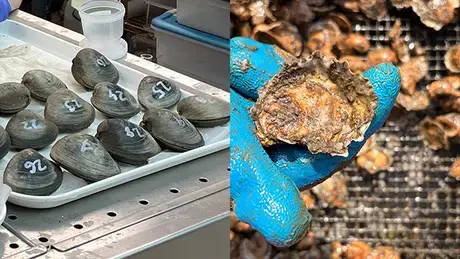
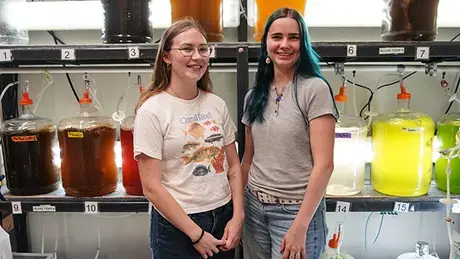
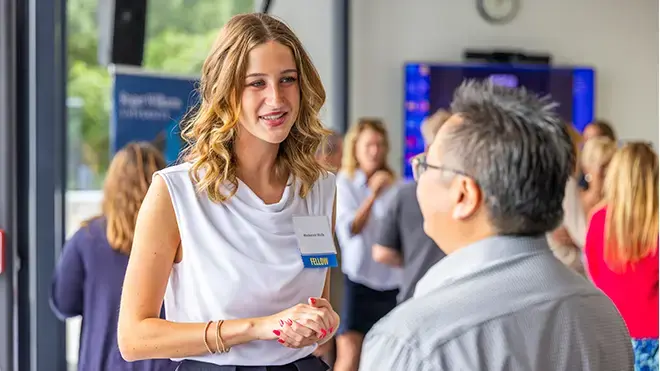
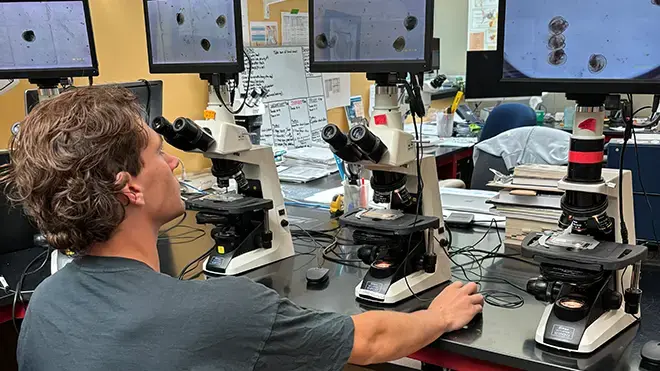
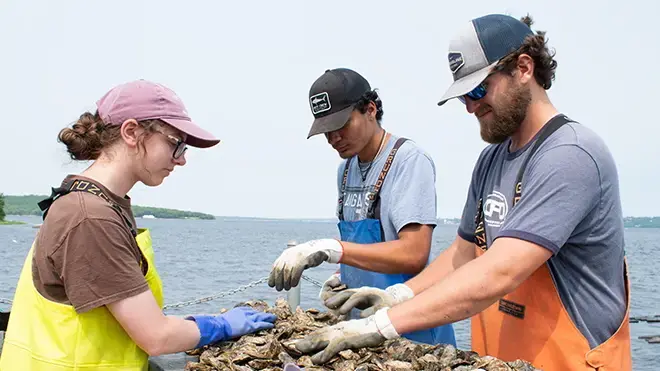
Through the Blue Fellows program, students are running oyster farms, managing high-tech hatcheries, and working in the Aquatic Diagnostics Lab (ADL). With new Blue Entrepreneurship pathways developed with the Gabelli School of Business, RWU Blue Fellows are graduating as both scientists and business leaders.
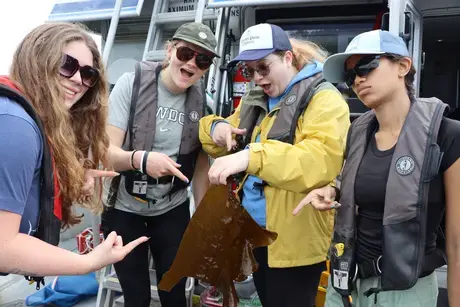
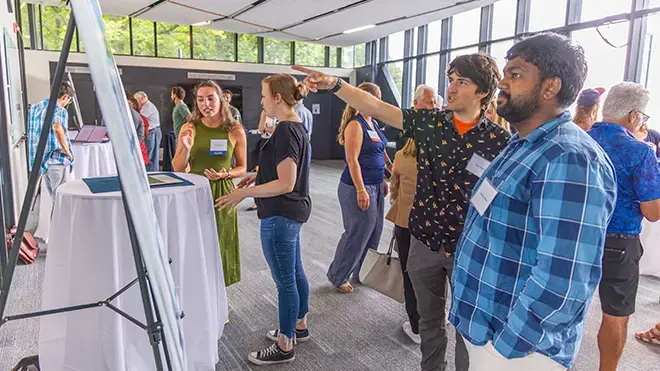
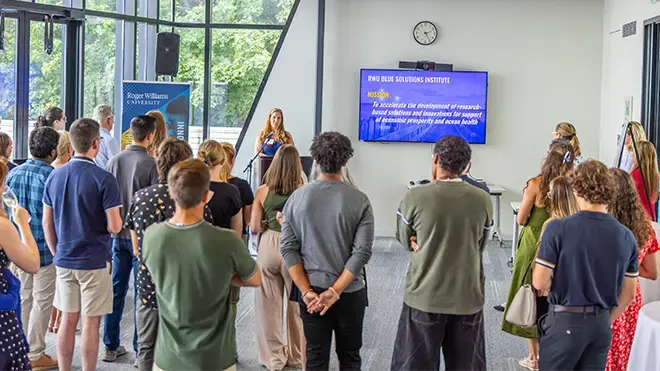
Part of RWU’s Blue Solutions Institute, the Blue Fellows Program offers students immersive, hands-on internships with faculty researchers and industry leaders. Projects span a range of urgent coastal and ocean issues – from oyster aquaculture and electric-boat design to shark conservation and marine diagnostics – providing seven students with opportunities to tackle real-world challenges while contributing to the advancement of blue economy solutions. The RWU Blue Fellows Program is supported by a generous gift from Elizabeth Moore, a venerable conservationist and environmental philanthropist and a 2024 RWU honorary degree recipient.
“The RWU Blue Fellows Program serves as a mechanism to spark cross-disciplinary collaboration and develop highly trained students prepared to lead meaningful change toward marine conservation,” said Koty Sharp, Director of RWU’s Center for Economic and Environmental Development. “This isn’t just about funding projects; it’s about creating the conditions for innovation – where students, faculty, researchers, and entrepreneurs come together to solve the ocean’s most pressing challenges.”
Blue Fellows Program
Made possible by philanthropist Elizabeth Moore HD’24, the new Blue Fellows initiative combines marine science, sustainability, and entrepreneurship to address coastal challenges and power the blue economy.
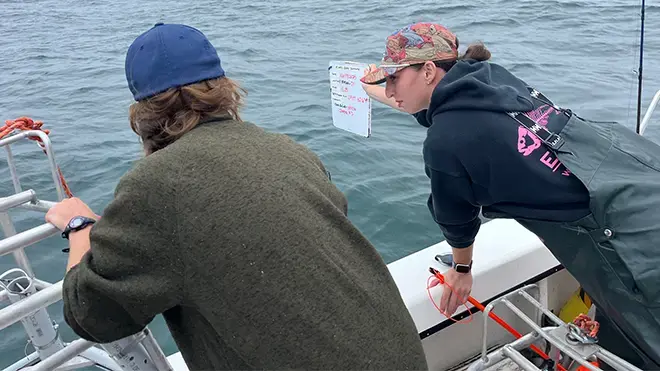
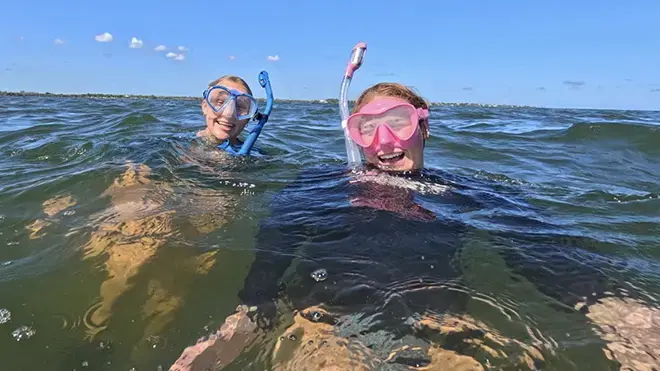
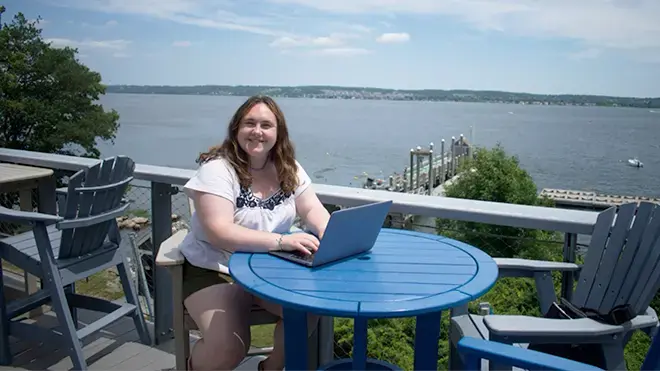
Mentorship and Professional Development
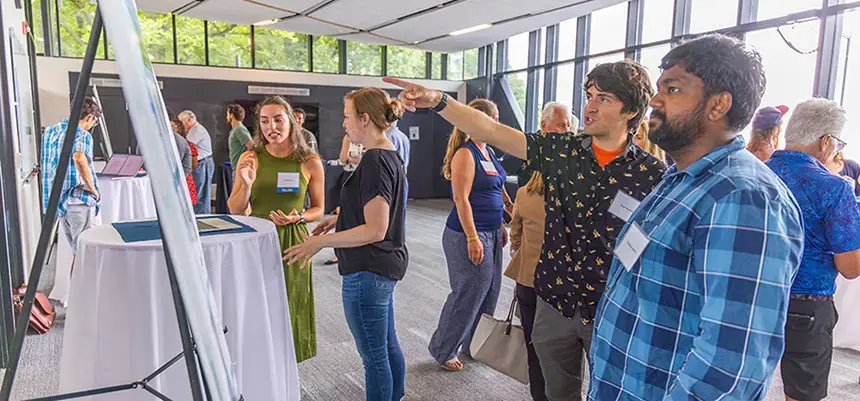
RWU’s Blue Fellows Program is designed to bridge classroom learning with applied research and innovation. Students are matched with faculty or external partners on projects that align with their interests and career goals. Over the course of the summer, students receive professional development, mentorship, and real-world experience that positions them for leadership in the rapidly growing blue economy.
“I had the opportunity to do things I’ve dreamed about since the fourth grade, and being in this position helped me build a really diverse skill set – from computer work to spending so much time in the field. But what stood out most was the mentorship. I always had people willing to guide me, answer my questions, and help shape my research.”
Talia Moine ’25
Blue Fellow
B.S. in Marine Biology
Research Associate at Maldives Underwater Initiative
2026 Blue Fellows
Aiden Perham ’27 will work with the CEED’s Shellfish Hatchery and FerryCliffe Aquaculture Farm, gaining first-hand practical knowledge of Rhode Island’s shellfish industry and of the biodiversity of Narragansett Bay. Mentored by Rob Holmberg, Shellfish Aquaculture and Hatchery Specialist, and Assistant Professor of Biology, and Malcolm Bowen, Aquaculture Extension Specialist, this Fellow will collaborate with partners to develop, deploy, and optimize methods to advance best practices for shellfish aquaculture and restoration. Perham will also work with Oyster River Ecology as part of a statewide initiative to explore new restoration and growing technologies.
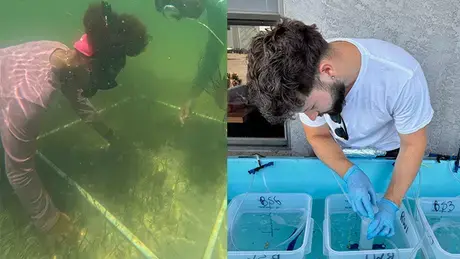
Branalysa Varela ’26 and Noah Curtin ’27 will work with the Gulf Shellfish Institute (GSI) in Palmetto, Fla., conducting shellfish aquaculture research. As part of an active collaboration between CEED and GSI researchers, the students will be testing new technologies for land-based aquaculture and field-based shellfish ecosystem monitoring.
Collin Phelps ’27 will work in CEED’s Aquatic Diagnostic Laboratory (ADL), led by Galit Sharon, Director of the ADL and Associate Professor of Marine Biology. There he’ll gain hands-on experience in aquatic animal health and disease diagnostics laboratory workflows and develop diagnostic methods.
Gillian Frey ’27 will work in CEED’s Coral Microbial Ecology and Biotechnology Laboratory, with Koty Sharp, and CEED’s Aquaculture and Aquarium Science Laboratory, led by Andy Rhyne, Professor of Marine Biology. Frey will be testing a probiotic treatment for its ability to protect a wide range of aquarium and aquaculture species from disease.
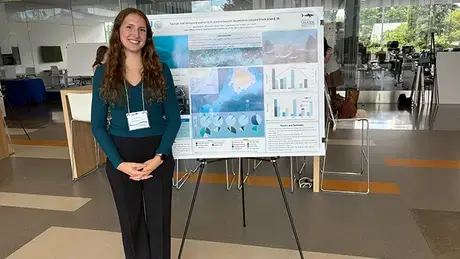
Grace Baldwin ’26 will continue the partnership between RWU and the Atlantic Shark Institute, mentored by Dave Taylor, Professor of Biology, on Baited Remote Underwater Video Systems (BRUVs) – an innovative, non-invasive method for monitoring marine ecosystems – to assess shark and fish biodiversity in the Block Island Sound.
Haley Kirkpatrick ’27 and Keegan Denahey ’26 will gain hands-on experience culturing algae and microbes at the Bigelow Laboratory Provasoli-Guillard National Center for Marine Algae and Microbiota. They will be trained in skills for microbial production of commercially valuable biomaterials, including pharmaceuticals, cosmeceuticals, and other natural products.
Cara Harvey ’26 will work in CEED’s Aquaculture and Aquarium Science Laboratory, mentored by Andy Rhyne, to develop technology to advance delivery methods of dietary supplements, medications, and treatments for aquatic animal health. The Fellow will also examine the translational and commercial potential of this work.
Ronan Peers ’26 will work under the supervision of RWU’s Dean of the School of Social and Natural Sciences as this summer’s High School Marine Biology Camp Assistant Director and Scientific Communications Blue Fellow. He will help coordinate and facilitate curriculum, as well as social media and web presence for the Camp program.