
Roger Williams University Expands Blue Fellows Program for Second Year of Ocean Innovation and Student Research
The annual fellowship initiative grows from seven to 10 fellows, introducing new partnerships to advance ocean research and the blue economy.
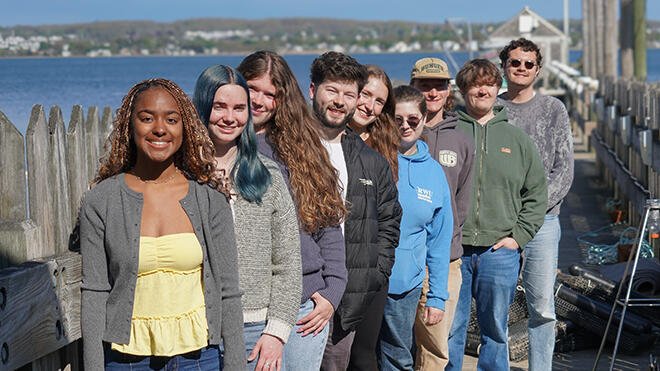
BRISTOL, R.I. – Roger Williams University (RWU) and its Center for Economic and Environmental Development (CEED) have announced the second annual Blue Fellows Program. The new season brings more opportunities for students to engage in marine research and entrepreneurship in support of marine science and sustainable aquaculture, both on campus and with industry partners.
Supported by a gift from philanthropist Elizabeth Moore HD’24, a marine conservationist from Sarasota, Fla., and Manchester-by-the-Sea, Mass., and funding from RWU’s High School Marine Biology Camp, the Blue Fellows Program builds on the success of its inaugural year by pairing students with faculty researchers and organizations working on ocean-based solutions by advancing marine biotechnology research and discoveries into market-facing products and solutions. The program is part of RWU’s Blue Solutions Institute, an interdisciplinary initiative designed to prepare students for careers in the blue economy by bringing together CEED’s strengths in marine biotechnology with the entrepreneurship programming in RWU’s Mario J. Gabelli School of Business.
“The Blue Fellows Program is workforce training for the rapidly expanding blue economy – our undergraduates engage in marine technology and biotechnology research projects,” said Koty Sharp, Director of CEED and Associate Professor of Marine Biology. “Our Blue Fellows spend the summer immersed in hands-on applied marine research, in which they are learning important laboratory and field skills that can serve them in a variety of careers after they graduate.” As part of the Blue Solutions Institute, many of the Blue Fellows’experiences extend beyond the laboratory. After the Fellows Program, undergraduate students can enroll in RWU’s new Blue Entrepreneurship coursework, where they explore the entrepreneurial aspects of research and innovation. This newly developed track at RWU is designed to help student and faculty researchers at RWU translate scientific discovery into new commercial opportunities and support economic growth for the region’s aquaculture, marine conservation, food innovation, and life sciences industries.
Following a successful inaugural year that supported seven fellows, the program has grown to 10 fellowship placements, broadening opportunities for students. The program has also expanded to welcome a new partner organization, Bigelow Laboratory Provasoli-Guillard National Center for Marine Algae and Microbiota in East Boothbay, Maine.
The second cohort of fellows will participate in projects that develop and deploy new technologies in fields spanning aquaculture, blue biotechnology, marine animal disease diagnostics and treatment, microbial pharmaceuticals, and shark and fisheries sciences. The fellows in this multidisciplinary program are mentored by research faculty and staff in the laboratory and the field. The Blue Fellows experience also includes scientific communication training, and some will even design business plans and learn about pathways to product commercialization as part of the summer internship.
Among the students participating in the program are:
- Aiden Perham ’27 will work with the CEED’s Shellfish Hatchery and FerryCliffe Aquaculture Farm, gaining first-hand practical knowledge of Rhode Island’s shellfish industry and of the biodiversity of Narragansett Bay. Mentored by Rob Holmberg, Shellfish Aquaculture and Hatchery Specialist, and Assistant Professor of Biology, and Malcolm Bowen, Aquaculture Extension Specialist, this Fellow will collaborate with partners to develop, deploy, and optimize methods to advance best practices for shellfish aquaculture and restoration. Perham will also work with Oyster River Ecology to explore new restoration and growing technologies.
- Branalysa Varela ’26 and Noah Curtin ’27 will work with the Gulf Shellfish Institute(GSI) in Palmetto, Fla., conducting shellfish aquaculture research. As part of an active collaboration between CEED and GSI researchers, the students will be testing new technologies for land-based aquaculture and field-based shellfish ecosystem monitoring.
- Collin Phelps ’27 will work in CEED’s Aquatic Diagnostic Laboratory (ADL), led by Galit Sharon, Director of the ADL and Associate Professor of Marine Biology. There he’ll gain hands-on experience in aquatic animal health and disease diagnostics laboratory workflows and develop new diagnostic methods.
- Gillian Frey ’27 will work in CEED’s Coral Microbial Ecology and Biotechnology Laboratory, with Koty Sharp, and CEED’s Aquaculture and Aquarium Science Laboratory, led by Andy Rhyne, Professor of Marine Biology. Frey will be testing a probiotic treatment for its ability to protect a wide range of aquarium and aquaculture species from disease.
- Grace Baldwin ’26 will continue the partnership between RWU and the Atlantic Shark Institute, mentored by Dave Taylor, Professor of Biology, on Baited Remote Underwater Video Systems (BRUVs) – an innovative, non-invasive method for monitoring marine ecosystems – to assess shark and fish biodiversity in the Block Island Sound.
- Haley Kirkpatrick ’27 and Keegan Denahey ’26 will gain hands-on experience culturing algae and microbes at the Bigelow Laboratory Provasoli-Guillard National Center for Marine Algae and Microbiota. They will be trained in skills for microbial production of commercially valuable biomaterials, including pharmaceuticals, cosmeceuticals, and other natural products.
- Cara Harvey ’26 will work in CEED’s Aquaculture and Aquarium Science Laboratory, mentored by Andy Rhyne, to develop technology to advance delivery methods of dietary supplements, medications, and treatments for aquatic animal health. The Fellow will also examine the translational and commercial potential of this work.
- Ronan Peers ’26 will work under the supervision of RWU’s Dean of the School of Social and Natural Sciences as this summer’s High School Marine Biology Camp Assistant Director and Scientific Communications Blue Fellow. He will help coordinate and facilitate curriculum, as well as social media and web presence for the Camp program.
The Blue Fellows Program reflects RWU’s continued commitment to advancing interdisciplinary marine research and entrepreneurship while strengthening Rhode Island’s position as a leader in blue economy innovation.
Launched in 2025, the Blue Fellows Program was created to bridge classroom education with applied research training to strengthen Rhode Island’s blue economy workforce. The inaugural cohort included student internship experiences in shellfish restoration, aquatic animal diagnostics, shark and fisheries monitoring, and marketing operations for the electric boating industry.