
Summer Research Showcase Puts Undergraduate Discovery on Display at Roger Williams University
Undergraduate students shared research spanning biotechnology, environmental science, marine biology, engineering, and chemistry, showcasing the breadth of hands-on discovery taking place across the university.
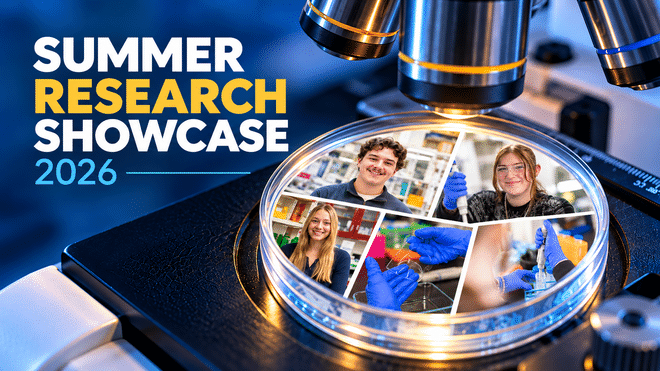
BRISTOL, R.I. – For 10 weeks this summer, Roger Williams University students traded traditional classrooms for laboratories, field sites, research vessels, engineering workspaces, and computer screens, joining faculty mentors and outside collaborators in pursuit of questions without predetermined answers.
Their work came together at the annual Summer Research Showcase, where undergraduate researchers presented projects spanning biology, chemistry, environmental science, engineering, biotechnology, and marine science to members of the RWU community.
The Showcase was co-sponsored by the Office of Research and Sponsored Programs; Feinstein School of Social and Natural Sciences; School of Engineering, Computing and Construction Management; Center for Economic and Environmental Development; and Science Alliance.
For Peyton Surprenant, Grants Specialist in the Office of Research and Sponsored Programs, the range of projects reflects a research culture that crosses academic boundaries and encourages students to think beyond their immediate results.
“Undergraduate research at Roger Williams University is very interdisciplinary and promotes collaboration across the institution. It’s evident in the students’ research that they have been encouraged by faculty to go beyond the data and consider the larger impact that their research has on their community.”
The Showcase also gives students another opportunity to develop a skill that becomes increasingly important as their work grows more complex: explaining what they have discovered and why it matters.
Peter Wong, Director of the Office of Research and Sponsored Programs, said the event brings to campus the work students previously presented at the Rhode Island Summer Undergraduate Research Symposium at the University of Rhode Island. It allows them to continue practicing how to communicate their research while introducing the broader RWU community to the depth of work taking place over the summer.
“The value of research is often discussed while the Showcase makes that value visible for everyone to see,” Wong said.
Unlike many classroom research projects that unfold within a semester, Wong said summer research often allows students to contribute to investigations faculty members and collaborators have pursued over several years. Along the way, students learn to formulate questions, develop research methods, analyze data, navigate ambiguity, solve unexpected problems, and communicate findings to both technical and general audiences.
“Students become part of a bigger quest to find answers to research questions,” Wong said.
That ownership stood out to Science Alliance President Diana Micalizzi, a senior Biochemistry major and Psychology minor, whose organization helped promote and co-sponsor the Showcase.
“Many students expressed how they had a say in the direction of their project and the overall goal,” Micalizzi said, noting that her own research experiences have similarly allowed her to pursue the aspects of a project that most interested her.
Science Alliance also hosted an Undergraduate Research Panel in the week leading up to the Showcase, part of an effort to encourage students who have not yet participated in research to learn from classmates who have.
Micalizzi said that peer-to-peer exchange was instrumental when she began conducting research herself, and presenting at events such as the Showcase also teaches students how to explain specialized work to people outside their own fields.
“I hope that they take away the amount of passion we all have for our research, and the rewarding results that have come from this passion and hard work,” Micalizzi said of students attending the Showcase. “I hope this will inspire our students to reach out and get involved.”
Meet the Student Researchers
Among the projects on display, students investigated questions ranging from the behavior of individual proteins to the movements of sharks along the East Coast.
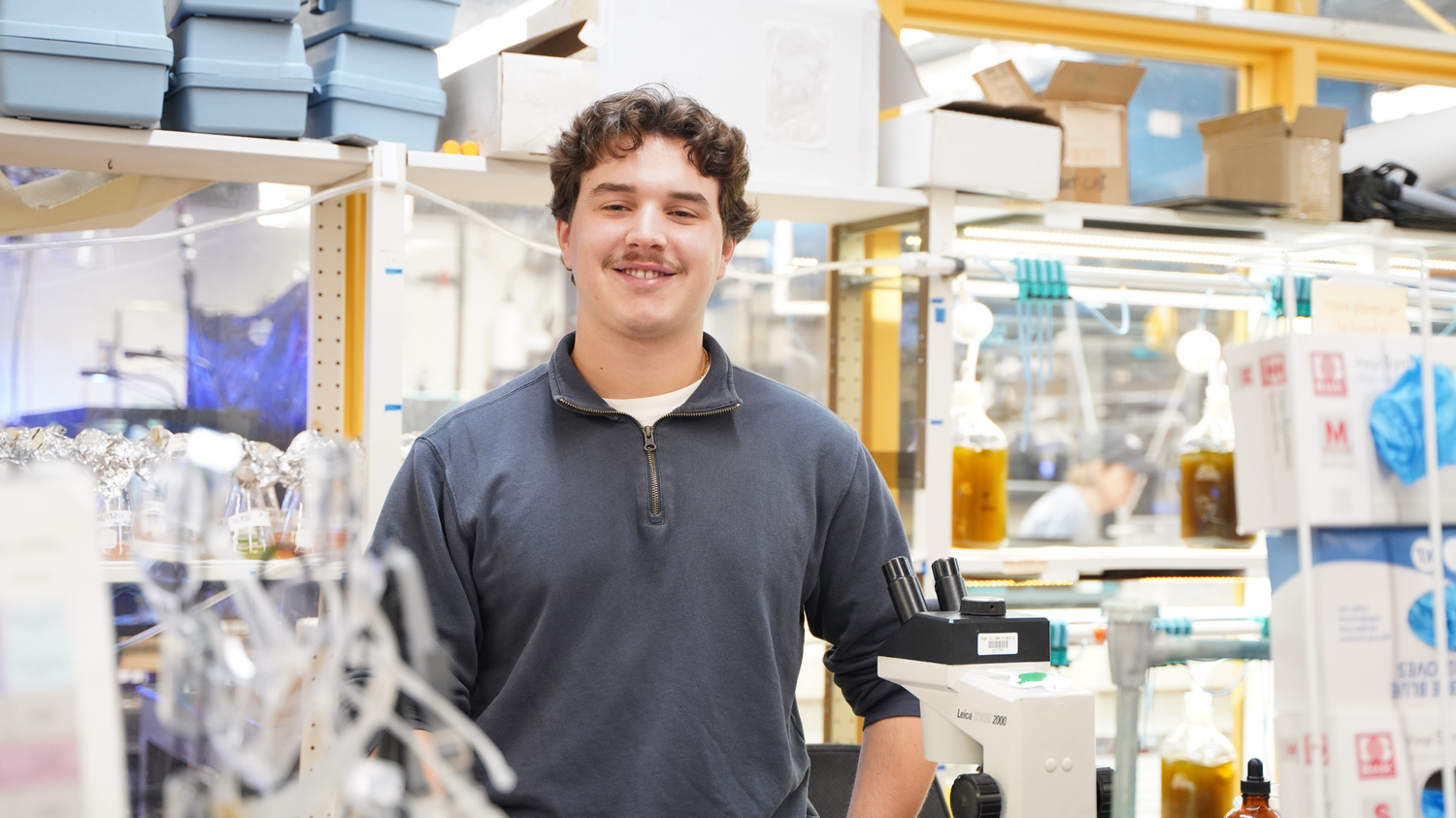
For Michael Natoli, a junior Environmental Science major and Marine Biology minor, research meant spending part of the summer doing something he had loved since childhood: fishing.
His project examined mercury contamination in stocked rainbow trout relative to wild bluegill and largemouth bass in Upper Melville Pond in Portsmouth. Over eight weeks, Natoli helped catch, process, and analyze fish, finding that mercury concentrations in recently stocked trout began increasing within weeks of their introduction to the pond. Resident largemouth bass contained substantially higher concentrations, illustrating how mercury can become magnified as it moves through the food web.
Click here to read more about Michael Natoli's research
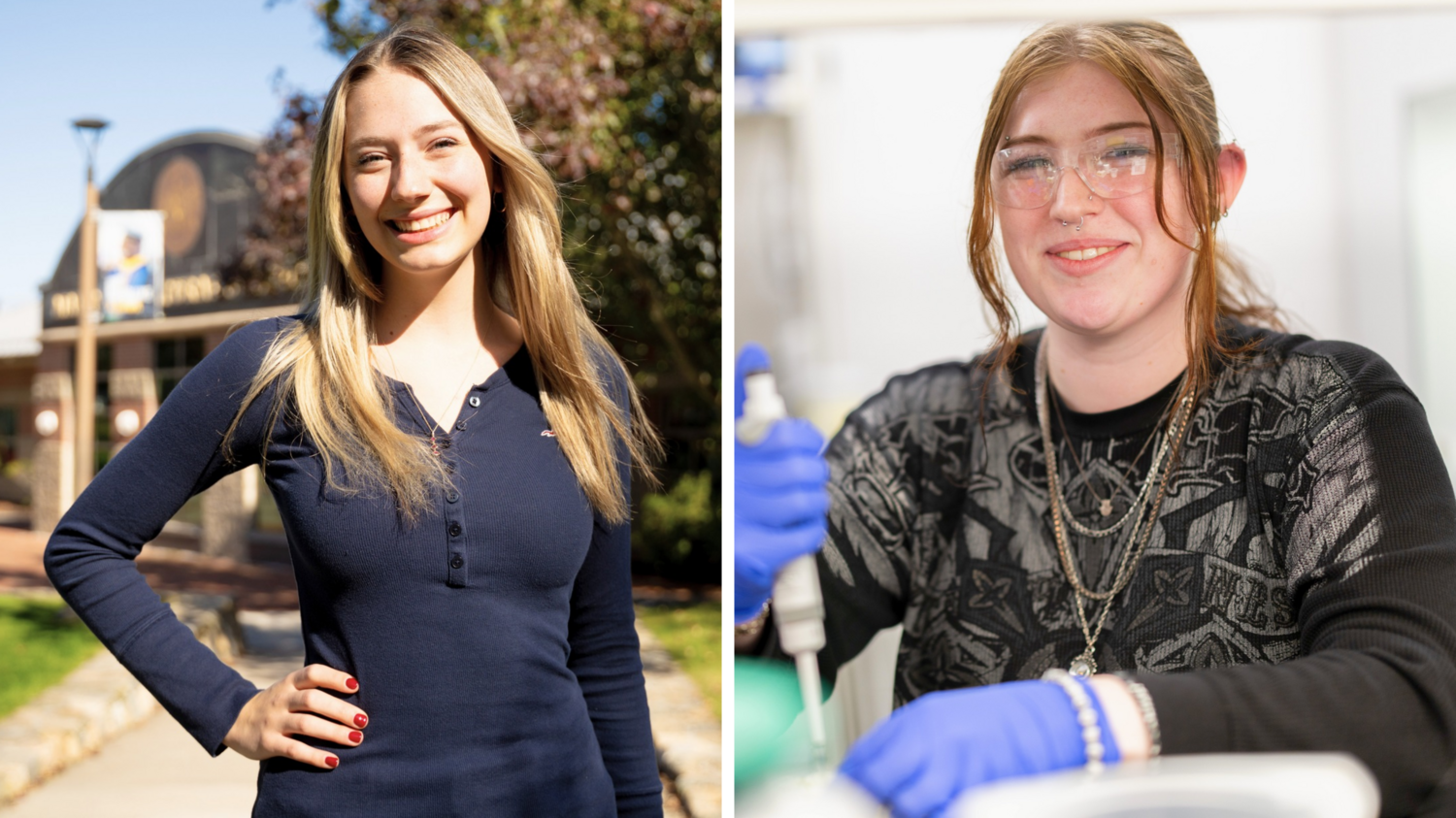
Taylor Mark, Mackenzie Marshall, and Maggie Fleming contributed to research in Assistant Professor of Chemistry Jane Thibeault’s lab examining protein stability from different angles.
Mark and Fleming screened oxidative-stress proteins for hyper kinetic stability, with Mark finding that human and mouse SOD2 did not exhibit the unusual stability the researchers initially expected. That unexpected result opened new questions about why proteins performing similar functions can behave differently. Marshall, meanwhile, worked on building liquid chromatography/mass spectrometry workflows that could allow researchers to measure protein stability more efficiently and eventually across larger datasets.
Click here to read more about Taylor Mark, Mackenzie Marshall, and Maggie Fleming's research
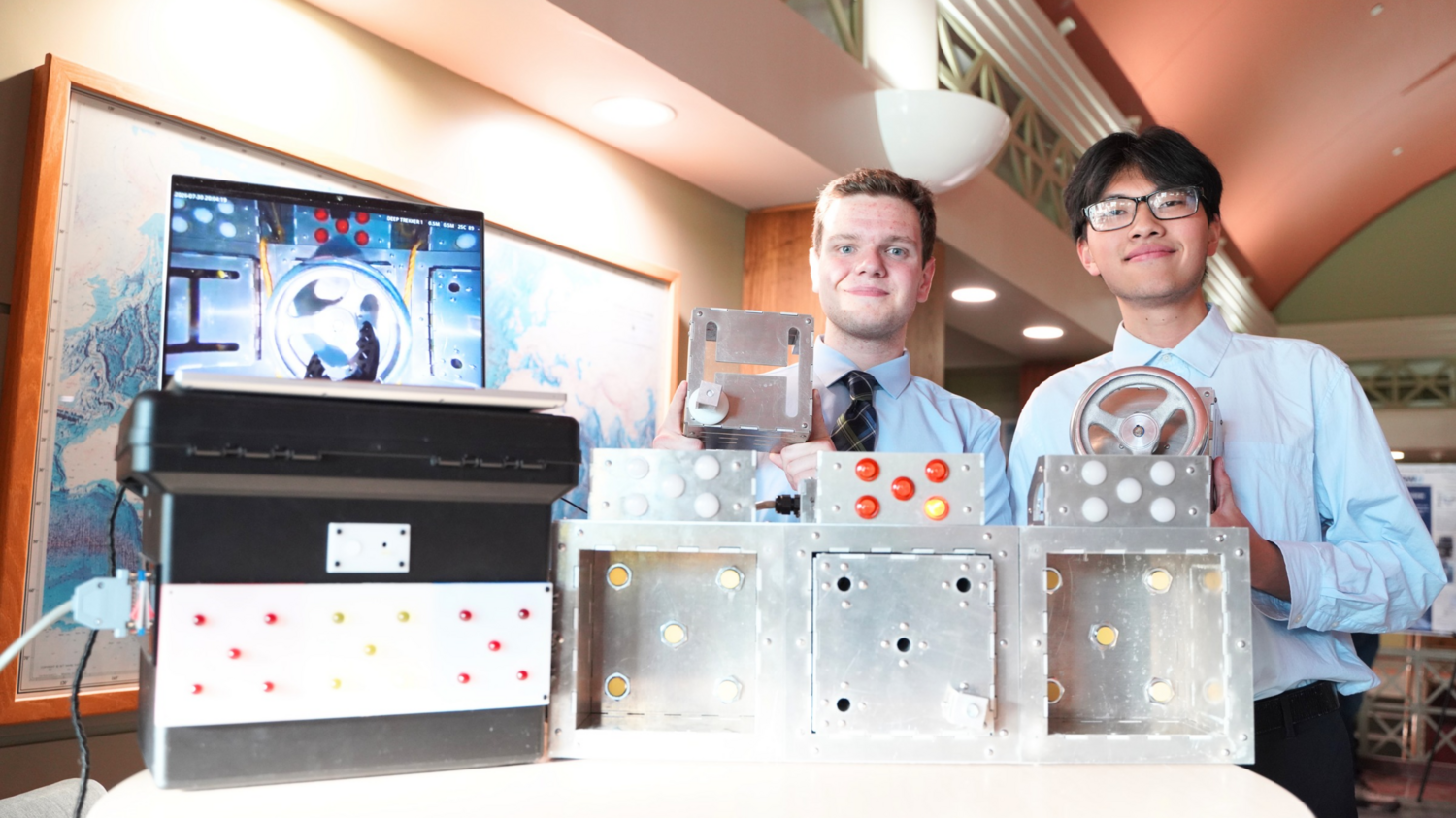
In engineering, seniors Chace Kirwan and Louis Zhu worked on a submersible sensorized autonomous manipulation platform, an aluminum system designed to test how well underwater robots perform tasks such as moving objects and turning valves.
Kirwan, a Computer Engineering and Electrical Engineering double major, focused heavily on electronics, sensing, and fabrication, while Zhu, a Mechanical Engineering major, worked on reducing the platform’s weight while preserving its structural strength. Their project is part of a larger externally supported collaboration involving underwater robotics researchers at other universities.
Click here to read more about Chace Kirwan and Louis Zhu's research
Together, the projects represent only a portion of the undergraduate research underway across RWU, but the Showcase offered students and visitors a chance to see that work side by side — and to see how questions pursued in a laboratory, on the water, or through an engineering prototype can become experiences that prepare students for what comes next.
As Surprenant put it, undergraduate research gives students the opportunity to present to audiences ranging from classmates to experienced faculty researchers while developing confidence in both their work and its broader significance.
For students at the Showcase, that meant more than displaying the results of a summer. It meant showing what becomes possible when undergraduates are given the opportunity to ask difficult questions, pursue the answers, and make the research their own.