
From Prototype to the Pool: Chace Kirwan and Louis Zhu Engineer an Underwater Robotics Test Platform
The senior Engineering students transformed an earlier plastic prototype into a durable, sensorized aluminum system designed to help researchers measure how successfully underwater robots perform real-world tasks.
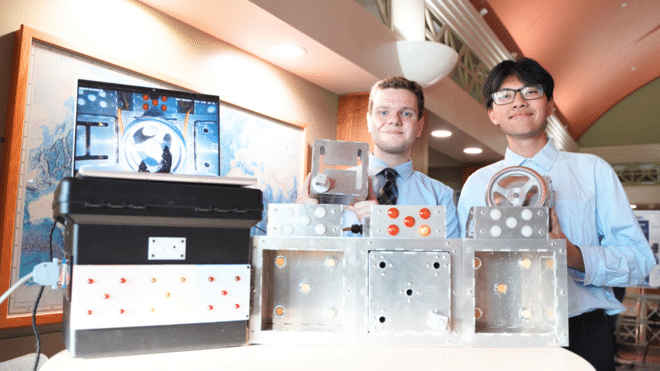
BRISTOL, R.I. – Before an underwater robot can be trusted to turn a valve, move an object, or interact with submerged infrastructure, researchers need to know more than whether the robot thinks it completed the task.
They need a way to prove it.
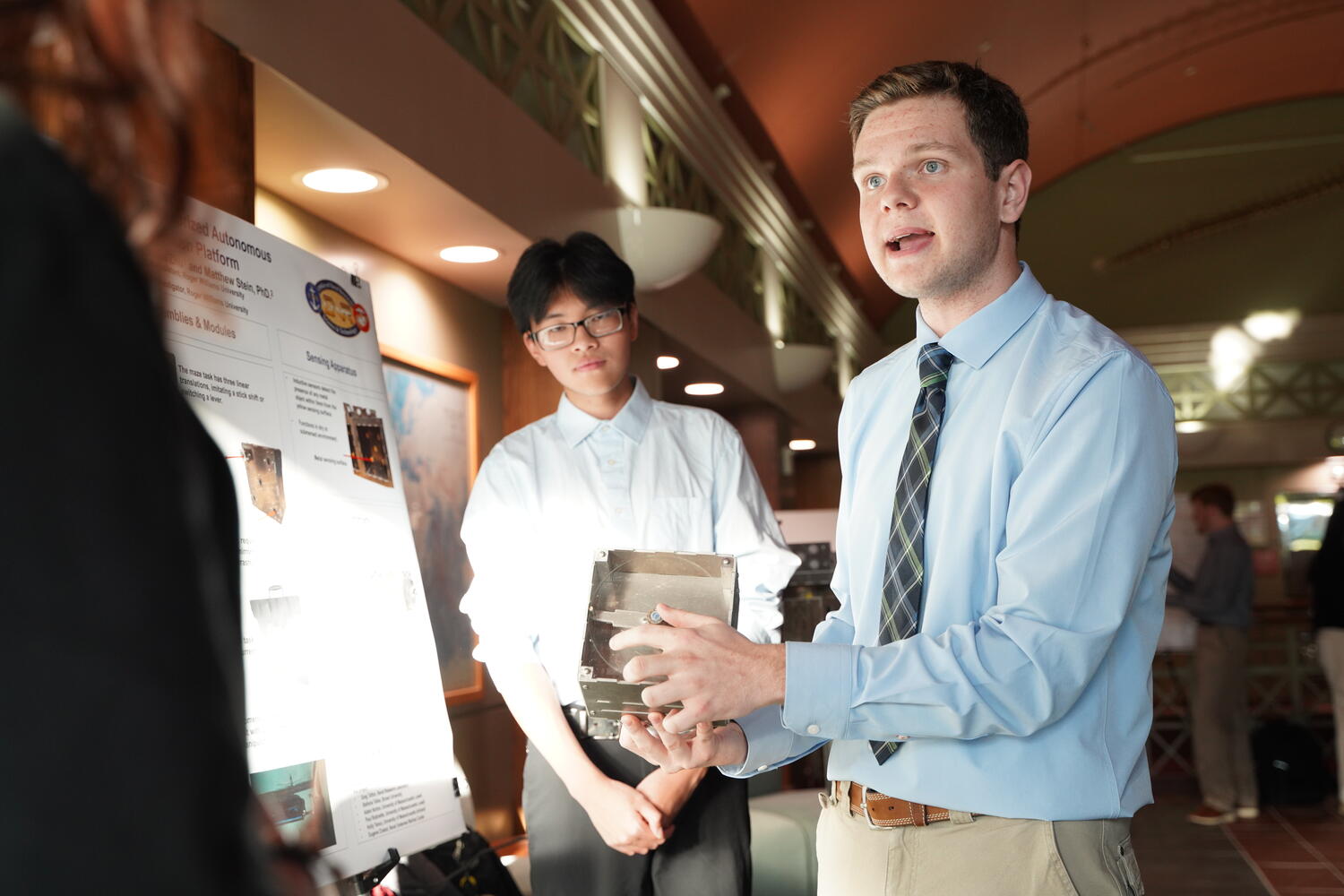
That challenge has driven seniors Chace Kirwan and Louis Zhu as they helped develop the “Submersible Sensorized Autonomous Manipulation Platform,” an instrumented underwater testbed that gives robots physical tasks to complete while independently recording their performance.
For Kirwan, a Computer Engineering and Electrical Engineering double major with Mathematics and Computer Science minors who has worked through multiple iterations of the project, the finished aluminum platform represents the culmination of countless individual design decisions.
“I feel an immense sense of ownership over our final aluminum design. It’s amazing how small decisions can snowball into design principles that get to be presented at this scale.”
For Zhu, a Mechanical Engineering major and Mathematics minor in the Honors Program, the payoff came when the designs and simulations he had spent months refining finally entered the pool alongside the underwater robot they were built to challenge.
“There’s something special about seeing an idea that you’ve spent so much time designing, modeling, and refining finally become a physical object, especially when you get to see it work,” Zhu said.
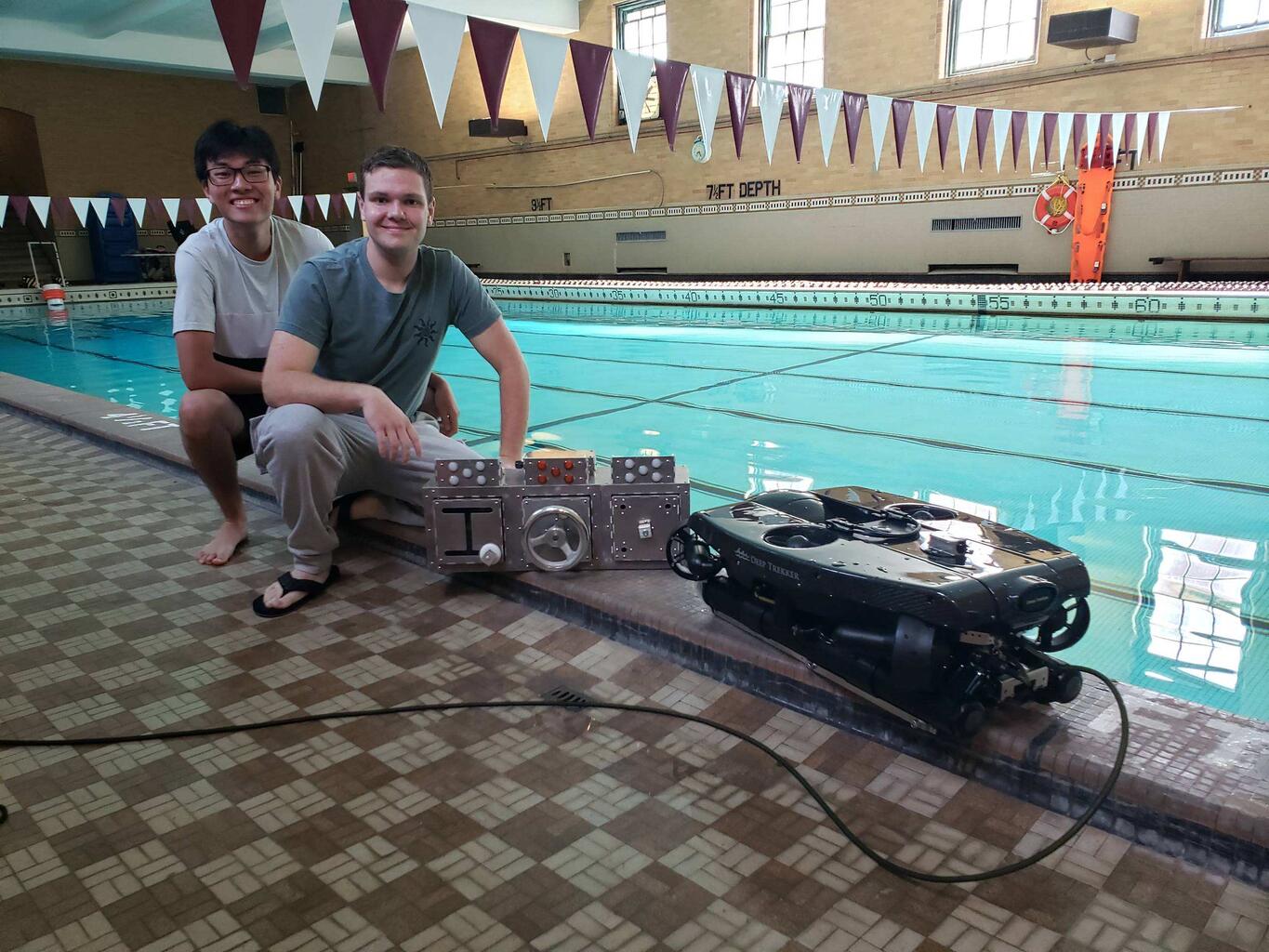
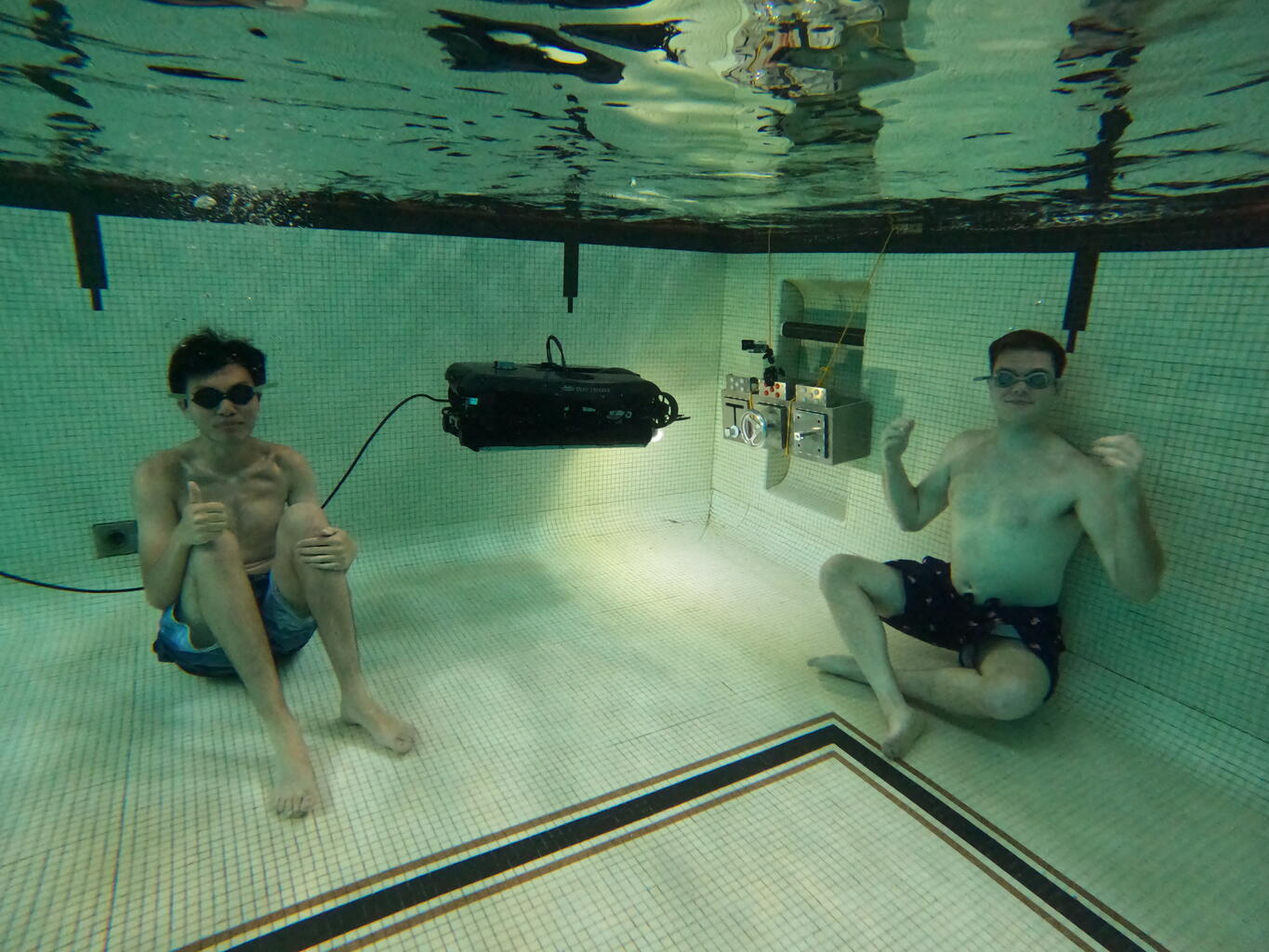
The project is part of an Office of Naval Research-funded collaboration with researchers at UMass Lowell, UMass Amherst, and Brown University. The RWU-built platform creates repeatable challenges for commercially available Deep Trekker underwater robots, including picking up and placing objects and manipulating valves. Sensors embedded throughout the platform register a robot’s progress and completion of each task, while data are recorded to an SD card and can be transmitted through Bluetooth for later analysis.
For Kirwan and Zhu, building its most advanced iteration yet required them to move continually between digital models, electronics, fabrication, structural analysis, and the realities of putting a machine underwater.
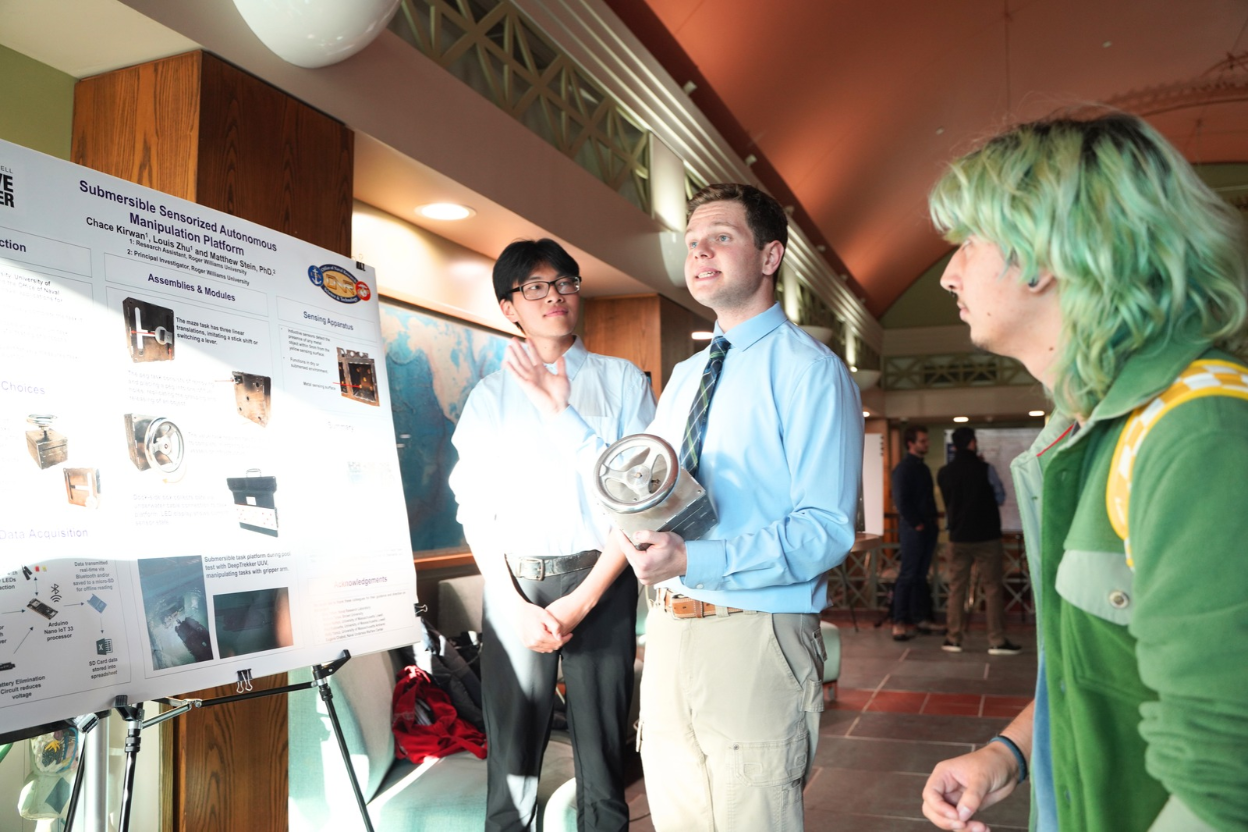
Building a Platform Made to Last
Kirwan had already worked on earlier versions of the system when Zhu joined the project. The previous platform was primarily constructed from plastic, including plastic fasteners and resin-printed structural components that could loosen, bend, deteriorate, or break over time.
The team wanted the next version to be stronger, more durable, and more representative of the infrastructure an underwater robot might encounter outside a laboratory.
Their answer was aluminum.
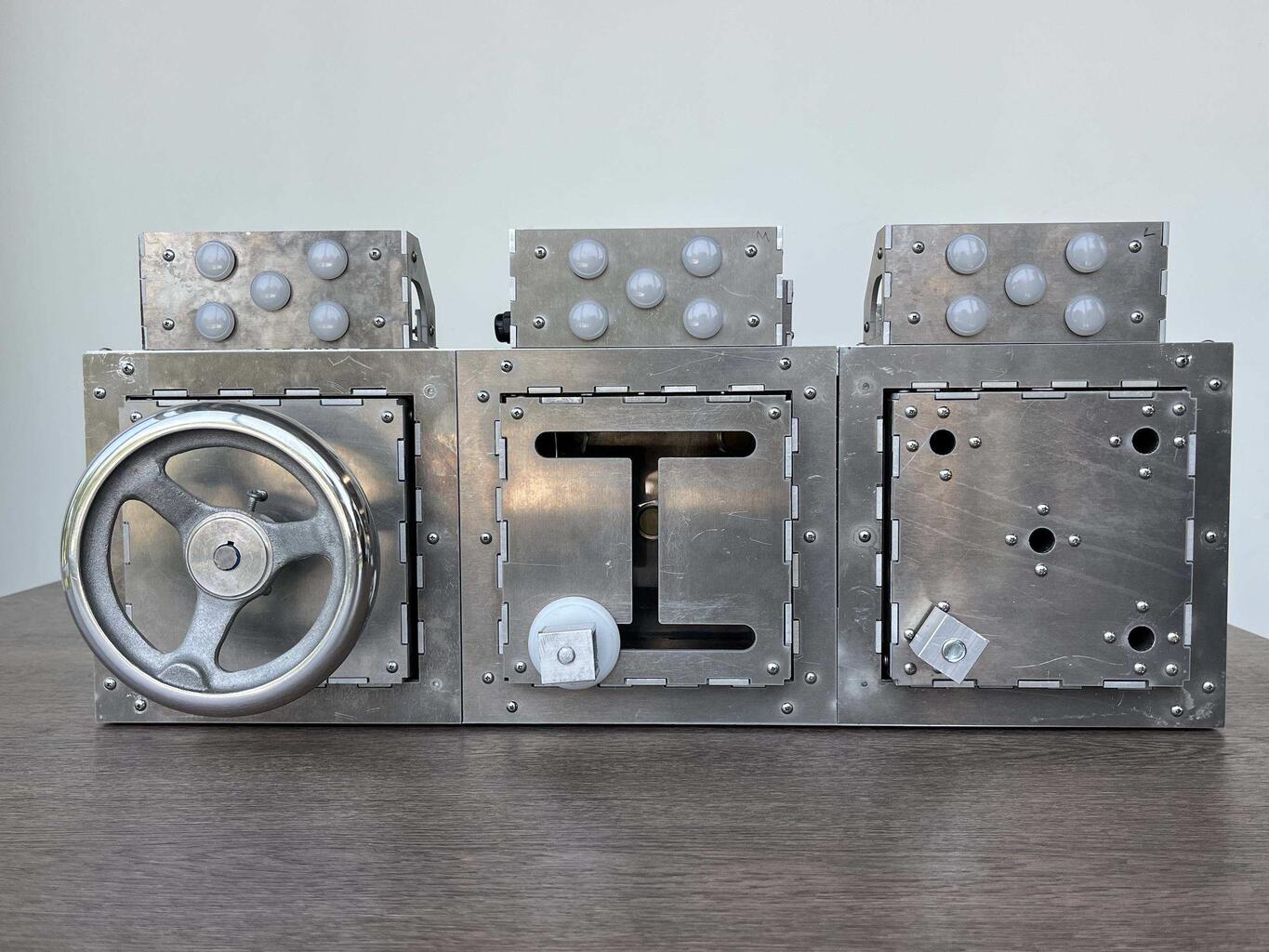
The shift became possible in part through RWU’s WAZER waterjet cutter, which allowed the students to manufacture two-dimensional aluminum components in-house. But replacing plastic with metal created an entirely new set of engineering problems, from weight and structural optimization to manufacturing tolerances and how to integrate waterproof electronics into the final structure.
Although their academic backgrounds gave them different areas of expertise, the students’ responsibilities did not divide neatly into “electrical” and “mechanical.”
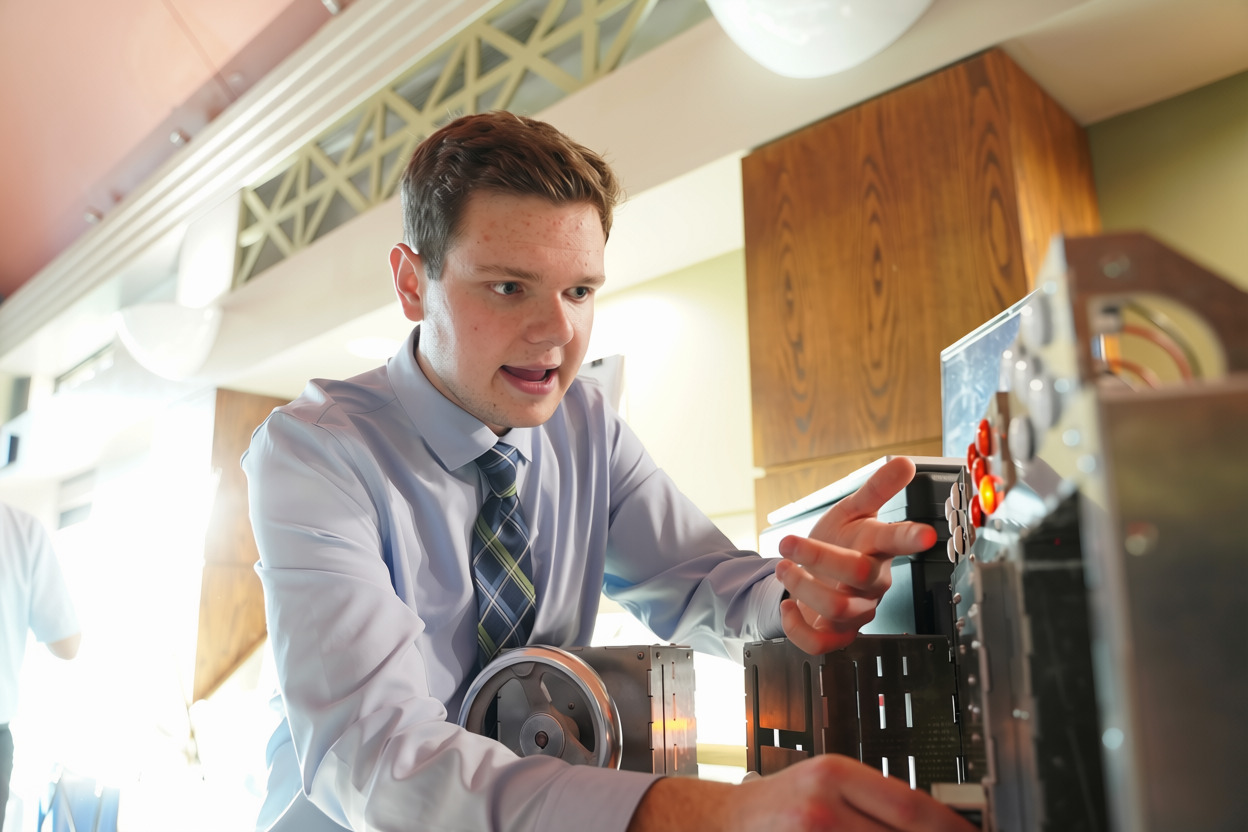
Kirwan, drawing on his previous experience with the platform, developed the principal design for the aluminum modules and handled the electrical system. Zhu worked extensively on building the complete final system digitally in CAD before manufacturing began, ensuring that everything from the aluminum plates to individual holes and screws fit together in the three-dimensional model.
Much of their summer, however, was spent manufacturing and assembling what they had designed.
The platform contains roughly 32 aluminum plates, with individual plates taking around two hours to cut. While Zhu frequently monitored the WAZER during the cutting process, Kirwan assembled completed pieces, drilled and tapped holes, corrected manufacturing issues, and eventually installed the electronics permanently inside the finished structure.
“You never really know if something’s going to work until you build it in real life,” Kirwan said.
Finding the ‘Lazy Material’
One challenge followed the aluminum platform from the beginning: weight.
The structure needed to be strong enough to withstand forces generated during underwater operation, but light enough to be moved, positioned, and retrieved during testing.
That balance became the focus of Zhu’s senior distinction research.
Working with faculty mentor Professor of Engineering Matthew Stein and Kirwan, Zhu used SolidWorks simulations to examine how components made from 6061 aluminum alloy responded to static and torsional loads. The simulations visually mapped where stress was concentrated throughout the structure, allowing the team to identify lower-stress areas where aluminum might be removed without unnecessarily weakening the system.
The students developed an informal term for those sections: “lazy material.”
By strategically removing material that contributed relatively little to carrying a load, Zhu could reduce weight while preserving the strength and rigidity the platform required.
“The challenge was finding that balance between weight reduction, structural integrity, and functionality,” Zhu said.
The students also designed corner brackets that allowed the platform’s aluminum frame to maintain its underlying structure even if some of its side or bottom plates were removed, giving the system additional flexibility while further addressing its weight.
But computer models could not anticipate everything.
When the students began cutting aluminum, they encountered kerf – the small amount of material removed by the waterjet during each cut. That meant some finished pieces did not precisely match the dimensions shown in SolidWorks, requiring the students to adjust their designs to account for the manufacturing process.
For Zhu, it was a reminder that engineering does not end once a model works on a computer.
When the Robot Thinks It Succeeded
The platform’s mechanical design is only part of the challenge.
Underwater robots must navigate three-dimensional space while currents and other forces continually affect their position. Their cameras can also contend with poor visibility and reflections, making something as seemingly simple as lining up a robotic gripper with a peg surprisingly difficult.
That is where Kirwan’s electrical system becomes essential.
The platform’s sensors provide an independent record of what physically happened during a task. Researchers can compare that information against what the robot’s own computer vision and sonar systems believe occurred.
If a robot picks up a peg and believes it has placed it into the correct opening, for example, the platform can confirm whether the intended sensor was actually triggered. If it was not, researchers know the robot’s internal understanding of the task did not match reality.
Kirwan’s work included rebuilding the platform’s electronics from the ground up after joining the project.
Waterproofing created a particularly unforgiving design constraint: once electrical components were sealed inside the system, they could not easily be changed or repaired. Kirwan replaced the earlier platform’s web of temporary wiring with more permanent electrical assemblies and converted connections in the dockside control box to a printed circuit board, reducing the loose connections and repeated adjustments that had plagued earlier iterations.
Even then, real-world problems continued to emerge. At one point, the team discovered that two different versions of an inductive sensor were being sold under the same component number. When a shipment arrived with a different electrical configuration, the students had to redesign part of the platform’s wiring around it.
Those are exactly the kinds of problems Kirwan said cannot be recreated completely through classroom exercises.
“There is no substitute for an engineering design project where none of those simplifications apply,” he said.
From Design Decisions to Something Real
By the end of the summer, what had existed first as drawings, simulations, wiring diagrams, and individual sheets of aluminum had become a finished system capable of being lowered into a pool and used by an underwater robot.
For Kirwan, one of the most meaningful parts of the project was the ownership he and Zhu were given throughout that process.
Stein, their faculty mentor, routinely reviewed their progress and stepped in when they needed assistance, Kirwan said, but otherwise trusted the students to make design decisions and solve the problems that arose.
That independence allowed ideas generated during informal brainstorming sessions to become permanent features of the final platform, giving Kirwan a firsthand view of how seemingly small choices can shape an entire engineering system.
Zhu felt a similar payoff when the finished platform finally entered the pool alongside the Deep Trekker robot.
After hours of modeling, reviewing designs, manufacturing components, and refining the structure, he could watch a machine interact with something that had previously existed only on a computer screen.
Seeing the system work, Zhu said, reinforced why he was drawn to mechanical engineering and research and development in the first place: taking an idea, confronting the technical problems between concept and reality, and working with others until the result becomes something tangible.
“You get to take an idea, work through technical challenges with other people, and eventually turn it into something tangible that works."
The experience gave both students something their engineering courses alone could not fully reproduce: responsibility for a project in which the constraints were real, the problems did not arrive with predetermined solutions, and the final product needed to work.
For Kirwan and Zhu, the result is now more than a prototype. It is a platform built to help researchers determine whether the next generation of underwater robots can do the same.