
RWU Brain Fair Turns Science into an Interactive Experience
Interactive exhibits and campus partnerships highlight the power of interdisciplinary learning and community engagement.
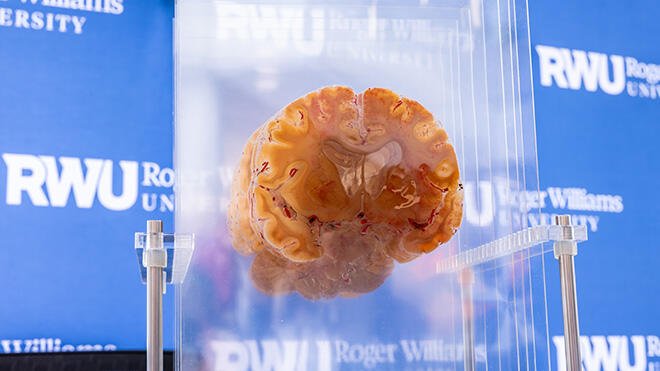
BRISTOL, R.I. – Global Heritage Hall transformed into a hub of curiosity and discovery this March as Roger Williams University’s second annual Brain Fair invited attendees to explore the science of the mind through hands-on learning.
Hosted by the student-led Brain Waves club, the event brought together students, families, and community partners from across Rhode Island for an afternoon of interactive exhibits, workshops, and conversations centered on brain health, mental wellness, and neurodiversity.
Tables throughout the space offered activities ranging from anatomical brain models to creative arts and crafts, while discussions encouraged participants to think more deeply about how the brain shapes everyday life.
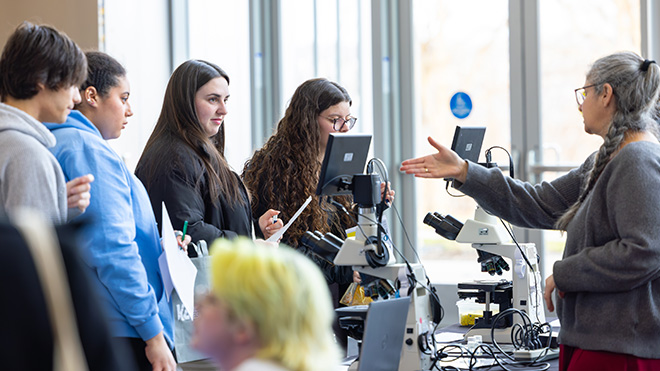
For students in attendance, the experience was both engaging and affirming of their academic interests.
“I’m taking neuroscience right now and really enjoying it, so I wanted to come out, support, and learn more,” said Hannah Damasio, a sophomore Psychology major from New Bedford, Mass. “It’s been really fun. It seems like there’s honestly something here for everyone.”
Sophomore Kennedy Engelke, a Criminal Justice major from Chepachet, R.I., said the event’s inclusive atmosphere stood out most.
“There are people of all ages here, and it just feels really welcoming,” Engelke said.
That sense of accessibility was a central goal for organizers. Nicole Van Deusen, a senior Psychology major and president of Brain Waves, said the fair was the result of months of planning and collaboration across the university.
“We spent a lot of time working with student organizations and the Feinstein School of Social and Natural Sciences,” she said. “We wanted to create something accessible for anyone, regardless of age or background.”
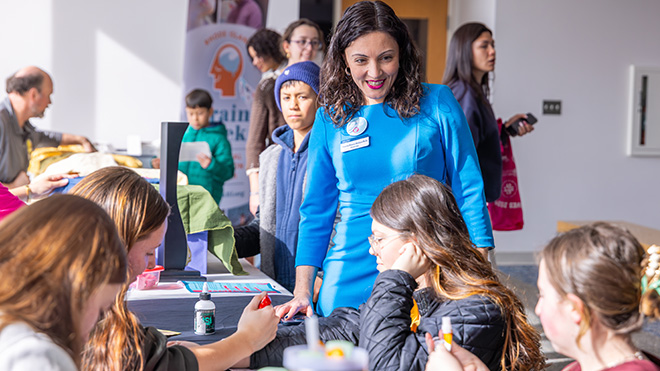
The event also extended beyond campus through partnerships with organizations across the state, including the Rhode Island Department of Health, as well as Brown University, Providence College, and the University of Rhode Island. Together, these collaborations reflect a shared commitment to expanding neuroscience education and public understanding of brain health.
That collaborative spirit mirrors the nature of neuroscience itself. Victoria Heimer-McGinn, Associate Professor of Neuroscience and Faculty Advisor for Brain Waves, emphasized the field’s reliance on multiple disciplines.
“Neuroscience is a very interdisciplinary field,” she said. “You need biology, chemistry, physics, engineering, mathematics – and when we put together a brain fair, we want input from all of those areas.”
For students, she added, events like the Brain Fair offer a window into how those connections take shape beyond the classroom.
“It’s important for students to see that professors collaborate,” she said. “All roads lead to the brain. There’s always going to be a connection.”