
From Public Health to Vaccine Development: Lila Saye ’23 Builds a Career Fighting Infectious Disease
A passion for science leads Roger Williams University Public Health alumna Lila Saye ‘23 down a career path of infectious disease research, vaccine development, and science communication.
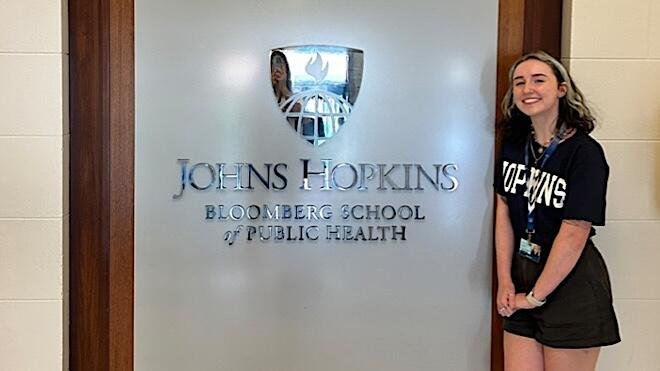
BRISTOL, R.I. — For Lila Saye ‘23, a childhood fascination with science has grown into a career investigating infectious diseases and how researchers can better prevent them.
The Roger Williams University alumna, who graduated in 2023 with degrees in Public Health, French, and Chemistry and a minor in Biology, has already studied viruses, bacteria, and vaccine development at some of the nation’s leading research institutions. Most recently, as an ITP-Vax Research Fellow at the University of Maryland’s Center for Vaccine Development and Global Health, Saye contributed to research on a potential maternal vaccine against Klebsiella pneumoniae, a bacterium that can cause severe infections in newborns.
Now, she has returned to the U.S. Food and Drug Administration as an Oak Ridge Institute for Science and Education (ORISE) fellow, where she is studying the hepatitis C virus using sequencing and bioinformatics – another step toward a longtime goal of understanding how pathogens evade the immune system.
It is a path Saye traces back to a curiosity about science that began years before she arrived at RWU.
A Curiosity for Science
Growing up in Bristol, Saye immersed herself in science through books at the local library, documentaries, science activities, and academic competitions.
“I’ve always been fascinated by science, even as a kid,” she said. “Many of my interests and hobbies revolved around learning about science.”
In high school, that broad fascination began to focus on infectious disease. After watching a documentary about the 2014-16 Ebola epidemic in West Africa, Saye became captivated by how public health systems respond to outbreaks and how pathogens interact with and evade the immune system.
“I became completely engrossed,” Saye said.
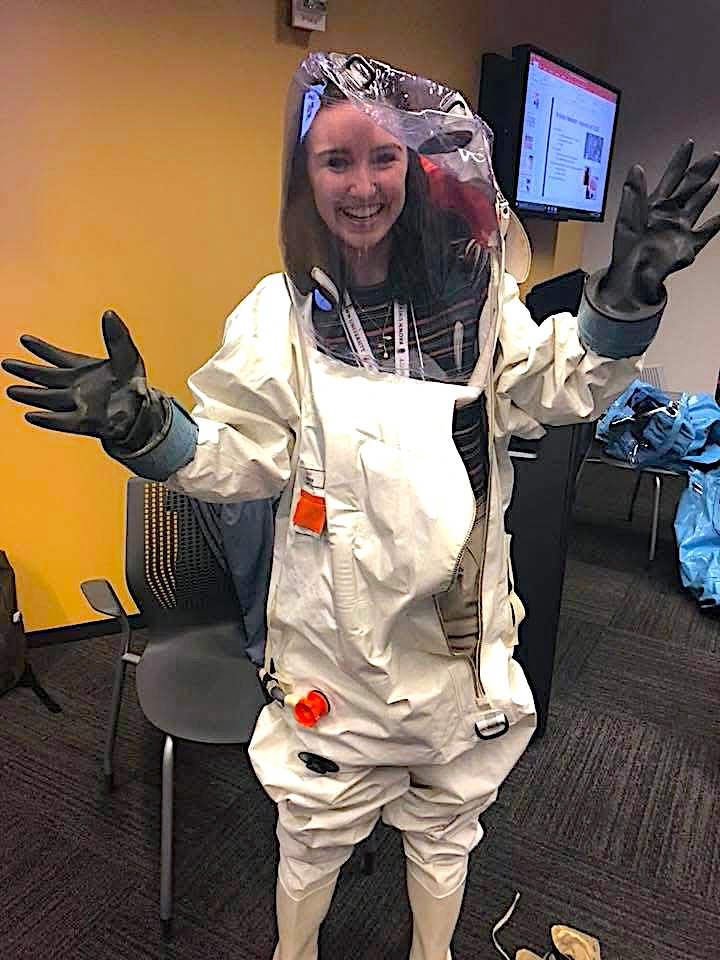
The summer before her senior year of high school, Saye attended a Brown University Pre-College program that took students to Georgia to study infectious diseases and visit the Centers for Disease Control and Prevention.
“It is one of my favorite memories,” Saye said. “I got to try on a Biosafety Level 4 suit, which you would need to wear if you study Ebola or other high-profile pathogens.”
By the time she began college, she knew she wanted research to be part of her future.
Finding Her Foundation at RWU
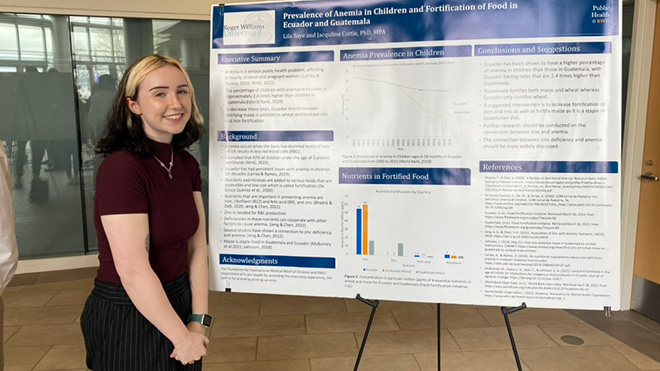
Saye’s connection to Roger Williams University also began early. Her mother was a professor at the university, giving Saye opportunities to spend time on campus before she became a student herself. When she returned for Accepted Students Day, the faculty, staff, and campus community helped convince her to stay close to home.
“I really enjoyed the environment and the faculty and staff, which is what made me commit,” Saye said.
Saye initially expected microbiology to dominate her studies, but Public Health introduced her to a broader way of thinking about science. Coursework spanning epidemiology, public health policy, ethics, and microbiology helped her understand disease not only at the molecular level but also through its effects on populations and communities.
“Having that comprehensive overview of public health has given me a really solid foundation,” Saye said. “It’s helped me sustain a broader lens when conducting scientific research.”
She complemented that academic foundation with experiences across campus. Saye served as a Peer Mentor, Orientation Advisor, chemistry tutor, and Honors Ambassador and participated in Science Alliance and the TriBeta Biological Honor Society. She also served on the executive boards of WQRI and the Foundation for International Medical Relief of Children (FIMRC).
Her work with FIMRC eventually led to an internship during her final semester, when she analyzed and visualized data for the organization as part of her capstone. She also gained early laboratory research experience during her senior year by assisting another student with thesis research examining changes in bacterial composition at postmortem intervals.
“Each experience at Roger Williams University really helped me come out well-rounded,” Saye said. “I owe a lot of my initial growth to those formative experiences.”
Learning to Communicate Science
One of Saye’s most influential mentors was Tracey McDonnell-Wysor, Director of the Tutoring Center and a former Biology professor.
Saye first met McDonnell-Wysor as a student in a biology lab before working with her as a tutor for three years.
“I can safely say that she is an incredible mentor and resource,” Saye said. “She is so supportive and kind, and I truly owe her and the tutoring center so much.”
McDonnell-Wysor said Saye brought more than a command of science to her work with fellow students.
“She’s a good listener,” McDonnell-Wysor said. “I think that’s important in communicating science to other people.”
That ability was especially evident in Saye’s work as a tutor.
“She was really good at listening to where they were, and then bringing them to the next moment,” McDonnell-Wysor said.
Those experiences helped Saye discover another passion: making complex science understandable.
A Writing 102 course taught her to think closely about the audience, and she later wrote an article for the science communication outlet Sciworthy translating a scientific paper for general readers.
“I think both have really helped me with making sure I keep my language accessible to a wide audience,” she said.
Science communication, once an unexpected addition to her research interests, has since become an important part of how she envisions her career.
From RWU to the Research Lab
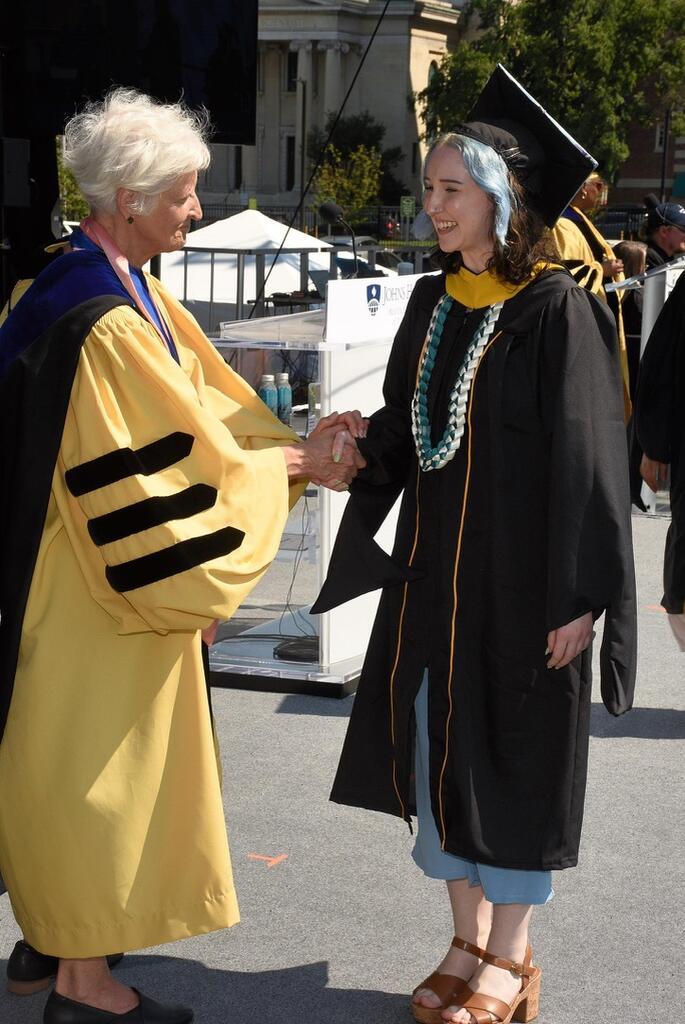
After graduating from Roger Williams University, Saye enrolled at the John Hopkins Bloomberg School of Public Health, where she earned an M.H.S. in Molecular Microbiology and Immunology.
She then joined the FDA through an ORISE fellowship and co-authored research published in the Journal of Biological Chemistry. The study helped develop laboratory methods to measure antibody responses to proteins from SARS-CoV-2, the virus that causes COVID-19.
Moving from the classroom into full-time research came with an adjustment.
“Prior to my ORISE fellowship at the FDA, I had never done full-time research, so it was very nerve-wracking the first few weeks,” she said.
She worried about making mistakes and appearing inexperienced. Before long, that apprehension gave way to confidence.
“I quickly grew to love it,” Saye said.
The laboratory also offered Saye something she had been working toward for years: the ability to take greater ownership of scientific questions and experiments.
“I love the freedom of being able to plan out my experiments myself and do hands-on research; it makes me feel like a true scientist,” she said.
Working Toward a Vaccine
Saye next became an ITP-Vax Research Fellow at the University of Maryland’s Center for Vaccine Development and Global Health in Baltimore, where her research turned toward Klebsiella pneumoniae, or Kp.
The bacterium can cause several types of infections, including pneumonia, urinary tract infections, and sepsis. Saye’s laboratory focused particularly on Kp infections that cause sepsis in newborns.
Her research contributed to an effort to develop a maternal vaccine against the bacterium. Because newborns are too young to receive many vaccines themselves, maternal vaccination can allow antibodies produced during pregnancy to pass from mother to baby and offer protection early in life.
“There are currently no licensed vaccines against Kp for either active or maternal immunization,” Saye said.
Antibiotic resistance makes the challenge even more urgent, she said, because some Kp can become increasingly difficult to treat.
“A maternal vaccine against Kp would give both mothers and doctors one less pathogen to worry about when it comes to neonates,” she said.
The vaccine would be distributed in sub-Saharan Africa and South Asia. “That is where the majority of neonatal sepsis cases and fatalities occur,” Saye said.
The vaccine remains in preclinical research and is not available for public use.
Saye’s project examined one piece of that larger challenge: how the carrier protein used in the vaccine influences the immune response.
Some bacterial vaccines target polysaccharides, or sugar-based components on the surface of bacteria. Because those components may not provoke a strong enough immune response on their own, researchers can attach them to a carrier protein that helps the immune system recognize the target.
Saye compared carrier proteins to determine which produced the strongest response against Kp. Much of that work involved Enzyme-Linked Immunosorbent Assay, or ELISA, testing of serum samples.
“In layman’s terms, I tested samples to see whether our vaccine has stimulated an immune response,” Saye said.
She then compared those results with tests examining bacterial killing and binding, as well as survival following exposure to the bacterium.
For Saye, the project brought together several strands of her academic and professional development: public health, microbiology, laboratory research, and the ability to translate complicated scientific work into language others can understand.
What Comes Next?
Saye has now returned to the FDA for another ORISE fellowship, this time studying the hepatitis C virus through sequencing and bioinformatics.
The work allows her to examine the pathogen itself – an area of infectious disease research that has fascinated her since high school.
“I’m also super interested in viral evolution and antigenic variation, the mechanisms pathogens use to evade the immune system,” Saye said. “I’m very excited to delve into this topic more.”
She is also applying to Ph.D. programs in microbiology and immunology. Earning a doctorate has been a goal for more than a decade and could lead her toward a career that combines research, teaching, and science communication.
For students beginning their own careers in public health or science, Saye encourages them to remain open to opportunities – including those they may not initially envision for themselves.
“Public health is an incredibly vast field,” she said. “There is so much to learn, so take advantage of any opportunities you have to learn something new.”
She also urges young researchers not to view setbacks as an endpoint.
“Never give up in the face of adversity. Let every rejection be one more reason to keep pushing, because one day that hard work will pay off,” Saye said.
McDonnell-Wysor said she is eager to see where Saye’s curiosity leads next.
“I could have predicted she’d be doing something super cool like this,” McDonnell-Wysor said. “I’m so excited that we were her place to grow and have these experiences, so that she could jump into these new opportunities.”
For Saye, the goal remains rooted in the same curiosity that first drew her toward science.
“I truly love science communication and research,” she said. “I’m going to keep working toward my dream.”