
Senators Reed and Whitehouse Visit RWU to Highlight Federal Investments in Blue Economy Research and Innovation
Federal funding has expanded RWU facilities supporting aquatic animal health, aquaculture research, student learning, and Rhode Island’s Blue Economy.
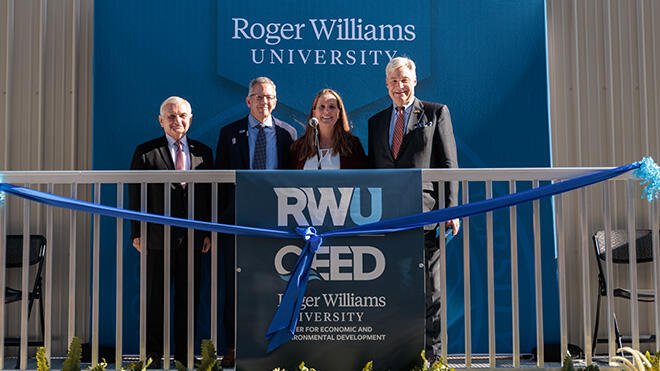
BRISTOL, R.I. — U.S. Senators Jack Reed (D) and Sheldon Whitehouse (D) visited Roger Williams University (RWU) Tuesday to tour new and upgraded research and teaching facilities supported by federal funding and highlight the university’s role in advancing innovation in the life sciences and Blue Economy.
The visit began at RWU’s newly completed Histology Laboratory, where the senators participated in a ribbon-cutting ceremony and learned about the facility’s role in aquatic animal health diagnostics, research, and student training.
“Roger Williams University has become a go-to resource for local shellfish growers – providing practical support to help launch and grow their businesses and help sustainably feed local communities. That success is not just in the classroom but also on dinner plates and more menus across the country as Rhode Island-grown oysters and other shellfish gain widespread popularity. I’m pleased to deliver federal funds to help Rhode Island’s aquaculture industry grow and expand to new markets. The new Histology Lab will help support this important local industry with new equipment to help researchers diagnose and prevent disease while training the next-generation workforce of Roger Williams students to graduate and continue to support our blue economy,” said Senator Reed.
“Aquaculture and marine research are twin pillars of Rhode Island’s growing Blue Economy,” said Senator Whitehouse, Ranking Member of the Senate Environment and Public Works Committee. “I was pleased to secure this federal funding, which will elevate RWU’s stellar marine research programs and maintain our state’s leadership in ocean economy entrepreneurship and innovation.”
The Histology Laboratory is part of RWU’s Aquatic Diagnostic Laboratory, which provides research and diagnostic services to fish and shellfish growers and regulators across the Northeast, with a specialty in diseases affecting bivalve mollusks. The new facility expands the laboratory’s ability to analyze aquatic animal tissues for disease-, stress-, and environmental-related structural changes using histology and immunohistochemistry.
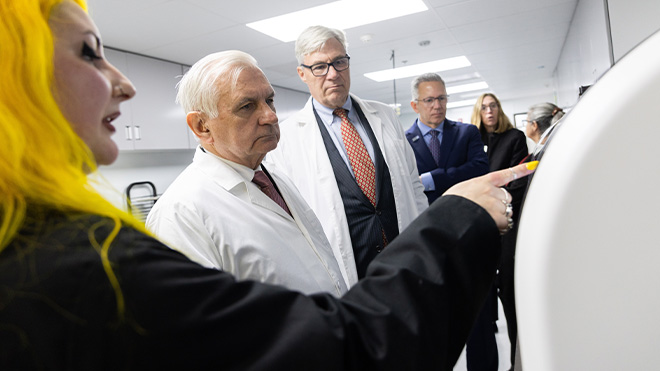
The senators’ visit highlighted two federal investments that have helped expand RWU’s research and educational infrastructure.
In 2022, Senators Reed and Whitehouse secured $1.6 million in federal funding for RWU to support the development of Rhode Island’s shellfish aquaculture industry. The National Oceanic and Atmospheric Administration (NOAA) award supported five areas of work, including expanding the shellfish nursery at RWU's Center for Economic and Environmental Development (CEED), new equipment for aquatic ecosystem health research in the Chemistry Laboratory, aquaculture-related research through RWU’s Marine Affairs Institute, and equipment and programming for the Food Studies program.
The funding also supported adding histology capacity to RWU’s Aquatic Diagnostic Laboratory. Grant records show that the university sourced and ordered equipment for the new laboratory and hired a Histology Laboratory Manager in December 2025 to oversee installation, laboratory setup, and operations.
“Senators Reed and Whitehouse have been longstanding champions of Roger Williams University’s work to advance Rhode Island’s blue economy,” said Brian G. Williams, D.M., Interim President of Roger Williams University. “Their leadership in securing federal investments has strengthened our ability to bring faculty research, student learning, and industry expertise together to address real challenges along our coast. We are grateful for their sustained commitment to this work, which extends well beyond any single award. These investments create extraordinary hands-on opportunities for our students, support innovation and sustainable growth in marine industries, and help Rhode Island’s coastal communities build a more resilient and prosperous future.”
The university also highlighted a $1.95 million FY24 federal award secured by Senator Reed, which complements the earlier investment and supports additional facility improvements at RWU. The USDA Animal and Plant Health Inspection Service award supported the histology laboratory space, diagnostic equipment, quarantine area, and personnel.
“These facilities reflect the power of connecting advanced research with hands-on student learning,” said Margaret Everett, RWU Provost and Senior Vice President for Academic Affairs. “By giving students access to specialized equipment, experienced researchers and real-world challenges, we are preparing graduates to contribute to the health of our coastal environment, the growth of the aquaculture industry and the future of the Blue Economy.”
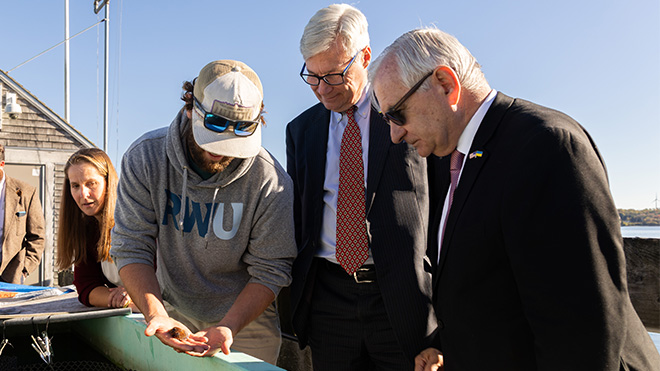
Following the Histology Laboratory visit, the senators toured additional RWU facilities, including the CEED shellfish nursery and dock.
The Chemistry Laboratory was upgraded with scientific instruments supported by the FY22 federal award, giving students opportunities to work with advanced equipment while conducting research related to aquatic ecosystem health.
“Thanks to the support of Senators Whitehouse and Reed, we have created a valuable resource designed to deliver rapid, reliable results that strengthen disease monitoring, research and regulatory efforts for the region’s aquaculture and seafood industries,” said Koty Sharp, Director of RWU’s Center for Economic and Environmental Development. “This investment expands our ability to support growers and regulators while advancing aquatic animal health research and providing students with hands-on experience in the science that sustains our coastal economy.”
Together, the facilities demonstrate RWU’s approach to connecting research, education and industry partnerships to address challenges facing Rhode Island’s coastal environment and economy.
The Histology Laboratory also provides hands-on training for RWU students, who gain experience with pathology and molecular approaches to aquatic animal health, diagnostics, and care.