
WQRI Celebrates 50 Years of Student-Run Radio
Students gathered on the D’Angelo Common for vinyl painting, music, Del’s Lemonade, and more as WQRI 88.3 FM marked five decades of student radio at Roger Williams University.
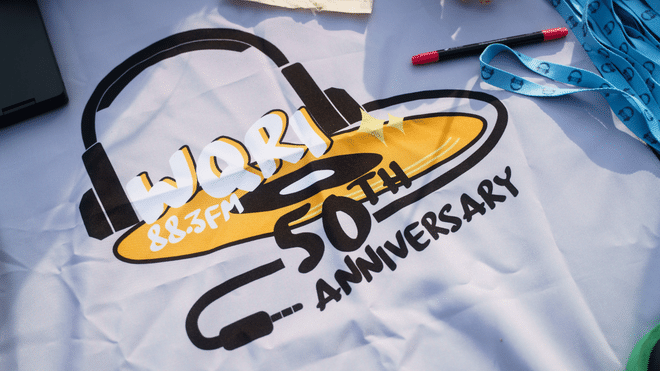
BRISTOL, R.I. – Fifty years after Roger Williams students began building their own campus radio station, a new generation of Hawks gathered on the D’Angelo Common to celebrate the music, creativity, and community that have kept it going.
WQRI 88.3 FM marked its 50th anniversary on Oct. 2, bringing its celebration into the heart of campus for College Radio Day. Students painted vinyl records, enjoyed Del’s Lemonade, listened to music, tested their radio and music knowledge with trivia, and joined in an afternoon celebrating the university’s student-run station.
The College Radio Day gathering followed a spring-semester celebration, marking the second time WQRI brought the campus community together to commemorate its 50th anniversary. Both events highlighted what the station has become: a place for students to discover music, try something new, and build a community around shared interests.
“Our 50th anniversary events have been some of our most exciting yet,” said WQRI Co-General Manager senior Skylar Gianninoto. “The vibe at our most recent College Radio Day event has been the best of them, with so many people coming out to support our station and college radio.”
From the station’s broadcast booth overlooking the celebration, Gianninoto experienced the enthusiasm through a steady stream of song requests, including some unexpected selections.
“I never knew how many college students were Steely Dan fans,” Gianninoto said.
Fifty Years of Student Voices
For Co-General Managers Bowie Diaz and Gianninoto, the anniversary year has also meant inheriting a tradition built by generations of students before them.
That tradition dates to 1976, when Roger Williams College students began transforming an existing radio club into WROG. With a student-written charter, funding from Student Senate, borrowed and assembled equipment, and space in the basement of a residence hall, students built a closed-circuit station whose 1560 AM signal traveled through campus wiring.
It was the beginning of an operation that would be rebuilt and reimagined many times over the next half-century.
Students spent years pursuing an FM signal, eventually adopting the WQRI call letters and, on March 9, 1989, broadcasting at 100 watts for the first time. The station expanded beyond campus, developed more professional programming and news operations, moved into its visible second-floor booth in the Campus Recreation Center, began streaming online, broadcast Hawks athletics, organized concerts and campus events, and adapted as the way people discovered and listened to music changed.
Through all of it, WQRI remained a station shaped by students.
Explore 50 years of WROG/WQRI history, including a timeline of the station’s defining milestones and individual profiles of the alumni who helped shape student radio at Roger Williams University.
“Fifty years is a huge accomplishment for the station,” said Diaz, a junior. “I can't even imagine what it must have been like in the very beginning for those students trying to create a space for students to involve themselves in radio because it seems to come so naturally to us now.”
For Diaz, the milestone is as much about the students who will follow as those who came before.
“To me it isn't just about leading the station now but thinking about what it might look like in 10 or 20 years when both Skylar and I are graduated and passing on such a special legacy to new students,” Diaz said.
Carrying the Tradition Forward
Today, any RWU student can become involved, learn how to operate the station, host a show, help organize events, and gain experience in broadcasting and production. WQRI continues to broadcast on 88.3 FM from Bristol while also reaching listeners online.
The Oct. 2 celebration capped a year in which the current WQRI E-Board has looked backward and forward, recognizing the people who helped build the station while continuing to create programming and events for today’s students.
Diaz said the spring and fall celebrations, along with anniversary-themed merchandise and social media posts, helped introduce more students to WQRI’s history and its longstanding place in the RWU community.
“I've been so happy to see the campus celebrate with us,” Diaz said. “Lots of people didn't seem to know how long WQRI has actually been a part of the RWU community which makes it even more special when people start to appreciate it even more.”
That growing appreciation reflects what Gianninoto considers the station’s greatest strength: its ability to bring together students with different backgrounds, interests, and ambitions.
“WQRI, to me, isn't the radio station or the events, it's the community that coalesces around a shared love of radio and allowing your voice to be heard,” Gianninoto said.
With members studying everything from Political Science and Marine Biology to Creative Writing and Cybersecurity, the station offers programming ranging from K-pop and country music to sports radio and talk shows. That diversity, Gianninoto said, is what makes WQRI accessible to students across the university.
The original WROG students started with equipment and an idea. Those who followed pursued FM. Later generations expanded the signal, built news and sports programming, brought concerts and live events to campus, added online streaming, and found new ways to keep college radio relevant in an era of Spotify, podcasts, and music on demand.
As Gianninoto prepares to conclude a final year on WQRI’s E-Board, the hope is that the 50th anniversary inspires another generation of students to take up that responsibility.
“This station has helped me a lot in my time here,” Gianninoto said. “I learned communication skills, leadership skills, and the most important skill of all, how to be myself and share that with the world, and I'm grateful to WQRI everyday for it.”
Now, 50 years after students first began assembling WROG, WQRI’s latest generation has the station.
And, like those before them, they are making it their own.