
Finding Purpose in the Crime Lab: How Paige Morris Shaped Her Path in Forensic Science
Forensic Science major Paige Morris gains hands-on experience as she prepares for graduate study at George Washington University.
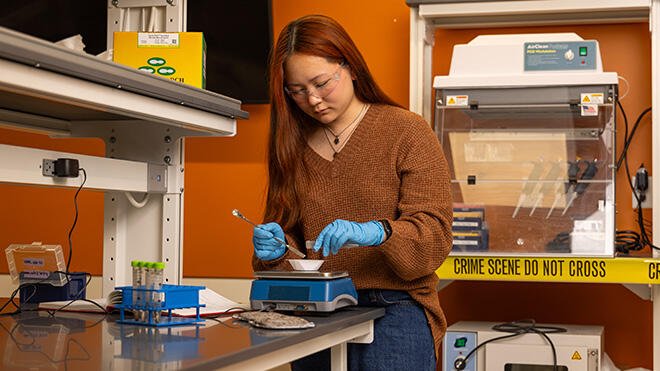
BRISTOL, R.I. – For Paige Morris, choosing a college wasn’t just about finding the right campus – it was about finding the right path. Now a senior Forensic Science major on the chemistry track with minors in Criminal Justice and Chinese, Morris arrived at Roger Williams University with curiosity but without a fully defined plan. What she found was a program and community that allowed her to explore, refine, and ultimately commit to a future in Forensic Science.
“One of the biggest things for me was that Roger has an actual Forensic Science major,” Morris said. “A lot of other schools I looked at only offered Criminal Justice or Chemistry with a Forensics concentration. Here, I could fully focus on Forensic Science and choose between a Chemistry or Biology track.”
That built-in flexibility proved essential. Students in the program do not declare a track until their sophomore year, allowing time to engage with foundational coursework before choosing a path. For Morris, that process led to a clear focus on chemistry and its applications in forensic analysis.
Her decision to attend RWU was also shaped by a sense of belonging. Coming from East Sandwich, Mass., Morris found Bristol’s coastal setting both familiar and comforting.
“It just felt right,” she said. “It reminded me of home, but still gave me that independence of being somewhere new.”
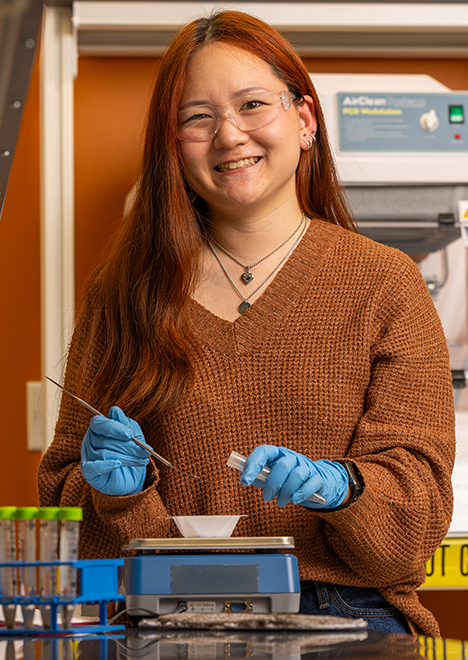
Morris’s interest in Forensic Science began in high school through coursework in fingerprinting, DNA analysis, and investigative techniques. But it was learning about the Innocence Project, an organization dedicated to using DNA evidence to exonerate wrongfully convicted individuals, that gave her ambitions a deeper sense of purpose.
“That really inspired me,” she said. “I want to help people who have been wrongfully convicted by the justice system, but without having to become a lawyer.”
At RWU, Morris has translated that motivation into both academic and applied experiences. Courses such as Forensic Science and Lab (FSCI 226) introduced core techniques, from fingerprint analysis to DNA extraction, while intensive lab work and report writing strengthened her precision and scientific communication.
She also developed a clearer understanding of the field’s realities, challenging common misconceptions shaped by popular media.
“One of the very first things you learn about is something called the ‘CSI effect,’ where people, thanks to TV, think results come back instantly,” Morris said. “That’s very much not the reality of forensics. It’s a very long process, but an important process.”
That emphasis on accuracy and patience has carried into her undergraduate research. Working with Assistant Professor of Forensic Science Chantrell Frazier, Morris developed a project examining soil analysis and DNA degradation.
Her research began with testing the reliability of DNA extraction methods from soil samples, followed by experiments exploring how environmental conditions affect DNA over time. Most recently, she has investigated how rising temperatures associated with climate change impact soil composition and DNA integrity.
“It’s been really interesting to see how something like heat can affect the data we rely on,” she said. “There’s still a lot we don’t know, which makes it exciting.”
Morris presented her findings at RWU’s Student Academic Showcase and Honors and has shared her work with prospective students, highlighting the opportunities available through undergraduate research.
Beyond the lab, she has taken on leadership roles across campus, serving as president of the Asian American Alliance and secretary of the Science Alliance, while also working as a peer tutor in Chemistry and Physics.
Her involvement began as a way to seek support in challenging courses but quickly evolved into mentoring others and forming lasting friendships.
“I always tell students not to be afraid to ask for help,” Morris said. “Going to the Tutoring Center is actually how I got involved in so many things.”
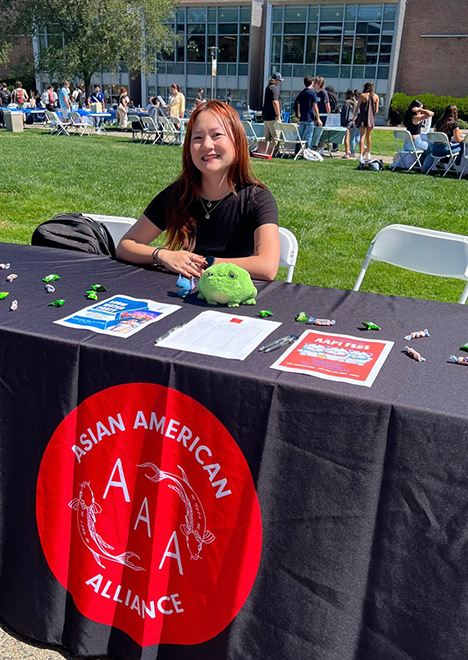
As president of the Asian American Alliance, Morris has helped foster cultural awareness and belonging on campus. One of the club’s signature events, API Fest, celebrates Asian American and Pacific Islander Heritage Month through performances, food, and education.
“It’s really meaningful to create a space where students feel seen and represented,” she said. “As someone who is adopted from an Asian country but grew up in a predominantly White area, and now attends a predominantly White institution, having that space is very comforting.”
Her academic interests also connect to that identity. “I am originally from South Korea, so while it’s not quite the same, it was an opportunity for me to learn more about Asian culture,” she said of her Chinese minor.
Morris credits RWU’s small class sizes and close faculty relationships as central to her experience. She points to mentors including Chantrell Frazier and Professor of Criminal Justice Eric Bronson as key influences.
“They really take the time to get to know you,” she said. “That support makes a huge difference, not just academically, but in building confidence.”
That confidence has been critical as Morris prepares for her next step: pursuing a Master of Forensic Science at George Washington University. After applying to four graduate programs and receiving acceptance to each, she chose GW for its professional connections and location in Washington, D.C.
“It’s an incredible opportunity,” she said. “Being in that area opens so many doors, especially in Forensic Science and criminal justice.”
Reflecting on her journey, Morris points not only to her academic accomplishments, but also to the relationships she has built along the way.
“The connections I’ve made with professors, classmates, and mentors are something I’ll carry with me long after graduation,” she said.
Her advice to incoming students is simple but powerful: take initiative and embrace uncertainty.
“Everyone coming into Roger Williams as a first-year student is in the same boat as you are,” she said. “You just have to put yourself out there. You can’t be afraid to raise your hand in class and ask a question. Don’t be afraid to take that first step.”
2026 Graduate Blog