
Workplace Justice and Organizational Leadership (M.S.)
At a glance
A Master’s in Workplace Justice and Organizational Leadership is a versatile degree that will equip students with key expertise and skills that can be applied in any industry, at any organization, and in any role. This is a ground-breaking interdisciplinary and versatile graduate program that provides students opportunities to develop skills and expertise through multiple approaches to workplace justice: e.g., research, policy development and analysis, law, project/people management, consulting.
Quick links
Workplace Justice and Organizational Leadership Program Facts
Schedule
Online learning paired with in-person residency
Credits Required
33
Time Commitment
1.5 to 3 years
Cost
2026-2027 Academic Year
$780 per credit
Fees
2026-2027 Academic Year
$145 per semester (online students)
Ways to Save
Apply By
Summer: March 1 (regular), April 1 (final)
Upcoming Events
Earn Your M.S. in Workplace Justice and Organizational Leadership at RWU
Imagine a workplace where:
- Conflicts are viewed as opportunities for growth and discovery.
- There are few, or no, obstacles to applying your best skills and expertise to achieve organizational goals in the best way possible.
- People get to focus their energy and time on the tasks that matter most like carrying out your role and supporting your colleagues.
- People are viewed as practitioners of talent that can be applied for the mutual benefit of all.
- Your strengths and identities are celebrated and not weaponized.
- Teams are strong and flexible, everyone has a clear idea of their role expectations, and mistakes are seen as learning opportunities.
Now, imagine a graduate program that can help you become the kind of professional who cultivates this kind of workplace. In this Workplace Justice Master’s program, students can choose the approach (e.g., public administration, law, business, policy) that suits their interests best.
Request Information

Online Graduate Program
The Workplace Justice and Organizational Leadership program is fully online after an initial three-day residency requirement.
Schedules
- Full- and Part-Time Sequences
- Sample Full-Time Schedule
- Sample Part-Time Schedule
- Three-Day Residency
The following sample schedules reflect one of many focuses (e.g., policy, research, law, management) a student could pursue, prioritizing completion of the five core areas first.
Some capstones could be 6 credits (e.g., Capstone 1, Capstone 2).
Students will have 9-12 elective credits (or 3-4 elective courses) to fulfill.
This program allows students to choose core courses and electives from multiple schools or departments within the University (e.g., public administration, leadership, business, law, justice) for tailor-made instruction and training through a workplace justice lens.
Policy admin focus, 33 credits
Summer
- Residency, WJS 501
Fall 1
- PA 515: Ethics
- PA 502: Organizational Dynamics
- PA 506: Public Personnel Management
Spring 1
- Methods
- Elective 1
- Elective 2
Fall 2
- Elective 3
- Elective 4/Capstone 1
- Capstone 1/Capstone 2
Policy admin focus, 33 credits
Summer
- Residency, WJS 501
Fall 1
- PA 515: Ethics
- PA 502: Organizational Dynamics
Spring 1
- PA 506: Public Personnel Management
- Methods
Fall 2
- Elective 1
- Elective 2
Spring 2
- Elective 3
Fall 3
- Elective 4/Capstone 1
Spring 3
- Capstone 1/Capstone 2
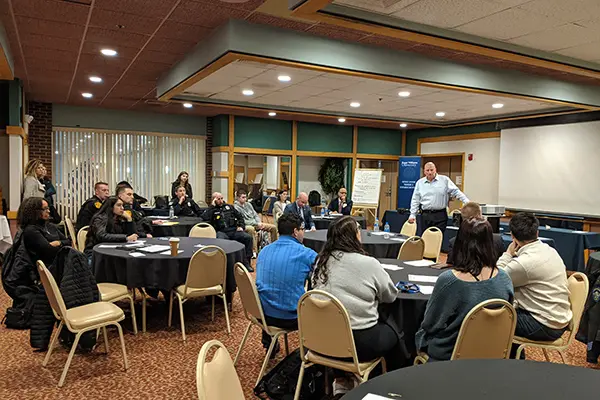
The three-day residency (6 credits) involves:
- Daily workshops, lectures, and discussions to onboard students into program
- WJS 501- Workplace Justice Foundations course
- Cohort cultivation to promote success throughout matriculation
- Expectation-setting exercises to help students prepare for success in the program
- Guest speakers discussing the role of workplace justice in different industries
- In-depth exploration of elective and capstone options
- Course planning workshop
- Critical skills building (e.g., law case briefing and scientific article analysis)
- Analysis exercises to identify areas of student interest and strengths

Careers for Workplace Justice and Organizational Leadership Graduates
Policy manager, Policy analyst, Human resources professional/manager, Change manager, Labor relations manager, Employee relations specialist, Compliance officer, Ombudsperson, Pay equity analyst, Consultant, Trainer, Researcher, Program director/coordinator, Project manager, Workplace climate specialist, Performance analyst

Transferable Skills
Scientific research and writing, Quality control compliance analysis, Legal analysis, Legal writing, Policy analysis, Policy development, Project management, Public administration, Change management, Consulting, Role analysis and development, Tangible employment action analysis, Performance management, Employment law analysis, Organizational change, Succession planning, Workforce continuity, Mediation, Conflict management, Team-building, Talent development and retention, Public speaking.
Application Requirements
- Application Process
- Application Materials
- Uploading Materials
- International Applicants
To be considered for admission to the Workplace Justice and Organizational Leadership (M.S) degree program, applicants must hold an earned Bachelor’s Degree from an accredited college or university, or currently enrolled and in good standing in an undergraduate program.
Each application will be reviewed using a portfolio approach - all parts of the application will be considered, inclusive of grades and trend of grades, letters of recommendation, the letter of intent, and other information that candidates for admission may wish to submit.
1. Completed application form and $55 application fee. Once submitted, you will receive an email with your admission portal username and password.
An application fee is not required for RWU students.
2. Official transcripts of all undergraduate and graduate coursework.
The Office of Graduate Admission will obtain transcripts on behalf of RWU students.
3. Letter of intent (no more than two double-spaced pages) describing your interest in the program, career goals, and how you can positively contribute to the graduate program at Roger Williams University
4. Two letters of recommendation, academic or professional, attesting to your potential to succeed in graduate school
5. Current Resume
Once an applicant has submitted the application form they will have access to a portal to upload all supplemental materials (transcript copies, letter of intent, portfolio, resume, etc.)
Alternatively, documents can be submitted via email to gradadmit@rwu.edu.
Any official documents that must be mailed (i.e. transcripts) should be sent directly to:
Office of Graduate Admission
1 Old Ferry Rd.
Bristol, RI 02809
This program is not visa eligible and cannot be completed remotely.