
Discovering Voice in Writing
Samantha Duncan, RWU Class of 2013 English Literary Studies Major
Being a writer doesn’t mean you have to limit yourself to only writing fiction or poems. Just ask Samantha Duncan.
Read about Samantha Duncan
Engaging students as critical thinkers, writers and cultural critics, the Department of History, English Literature, and Cultural Studies guides students toward meaningful professional lives by helping them develop transferable skills.
The Department of History, English Literature, and Cultural Studies prepares students for meaningful and rewarding lives, cultivating their curiosity and knowledge of history, literature, and culture while also developing transferable, AI-proof human skills that are valued across the professional world.
RWU History, English Literature, and Cultural Studies students engage in lively and relevant conversations about ways of knowing the past, the impact of ideas on lived reality, and the central role of culture, representation, and creativity in human life. Our students become skilled readers of historical artifacts and literary texts, smart consumers of culture (from literature with a capital L to the popular media we all enjoy today), and effective communicators in all modes and across platforms.
While enjoying close mentorship provided by faculty in the Department, our Majors and Minors also build Powerful Combinations by mixing and matching other RWU academic programs that feed their interests and serve their goals, like Creative Writing, Journalism and Media Studies, Secondary Education or Educational Studies, Graphic Design, Film, and Legal Studies. Students also enjoy an array of opportunities to take their learning outside the classroom, from community engagement and experiential learning opportunities to off-campus internships, study abroad, and our FIT Internship program (available to students with work study financial aid).
Faculty in the Department of History, English Literature, and Cultural Studies support people's right to protest against oppressive systems, to find ways to make their voices heard when they are ignored, silenced, or erased by those who hold power. As faculty who study the past and its ramifications for our present, we know that effective protests have not always been peaceful, and that "civility" is often a word deployed as a tactic to control people's behaviors. In "More Devoted to Order Than to Justice," Ibram X. Kendi wrote: "If my ideological ancestors did not harass their political opponents, I would still be enslaved. I would still be segregated by law. I would still be one traffic stop away from death without any sustained movement insisting that my black life matters...Constructive confrontation is love."
As educators, our front line is the classroom, and our tool is knowledge. In our classes, students will learn about oppression, power, and privilege in history and in our present, in order to have a critical understanding of the origins of systemic and institutional racism in the U.S. and the world, and the mechanisms by which they are enabled and maintained.
Dismantling oppression and doing anti-racism work requires us to reflect on ourselves, listen to the experience of others, and know history so that we do not continue to repeat it. In that spirit, we are providing resources to foster awareness, understanding, growth, and action.
Our student magazine, Voices, gives you the chance to submit your work and get published. Whether its poetry, fiction, nonfiction, or just snippets of daily life, we want to hear from you.
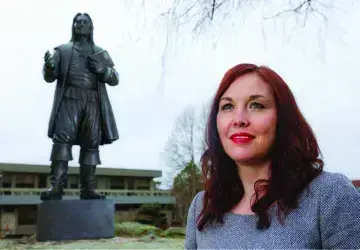
Associate Professor of History Charlotte Carrington-Farmer was one of the consulting historians for “Slaversville: America’s First Mill Village” documentary on RIPBS. Three RWU students worked on a community engaged project that was central to the making of the documentary. Ben Scheff '18, Emma Ledoux '18, and Nataliya Murphy '16 worked on transcribing a range of 18th and 19th-century letters for the film and their names feature in the opening credits.
Watch the Documentary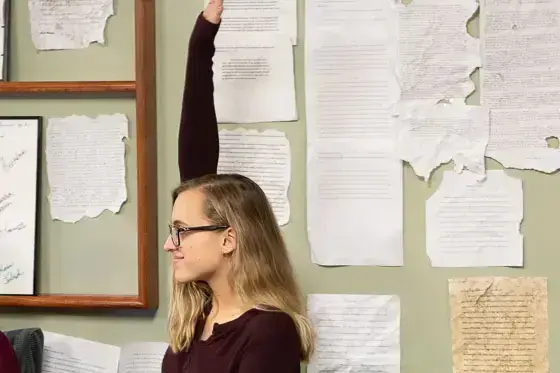
We offer major and minor degree programs for History. From ancient Assyria or Chiapas land rights, to the American home or steampunk comic-book culture, we are ready to enhance your academic experience.

Reading, writing, analyzing and researching to change the world.

Cultural Studies peers beneath the surface of the pop culture you consume, the music you listen to, the clothes you buy, the foods you eat, the places you visit, the speeches you hear, the things you read, and the art you see. We invite you to examine impact of identity on American culture.
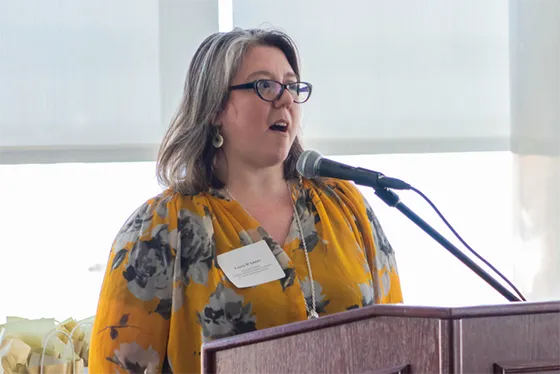
Our faculty, made up of nationally and internationally recognized teacher-scholars, leads students in the study of literary and cultural history, form and aesthetics, and critical methods while emphasizing the development of the skills, creativity, and cultural literacy that students will apply throughout their work and lives.
Being a writer doesn’t mean you have to limit yourself to only writing fiction or poems. Just ask Samantha Duncan.
Read about Samantha Duncan