
Chris Belmonte ’20 M’22: ‘Part of My Identity’
From spinning disco behind the mic to helping replace WQRI’s aging transmitter, Chris Belmonte's six years at the station gave him a creative escape from architecture while helping prepare 88.3 FM for the next generation.
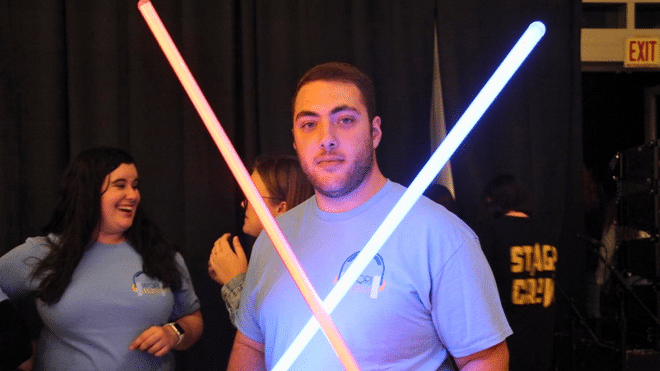
Chris Belmonte ’20 M’22 opened his first WQRI show with Tavares’ “Don’t Take Away the Music.”
Six years later, as his final broadcast came to a close, he returned to the same song.
It was a fitting bookend to an RWU experience in which WQRI became nearly inseparable from who Belmonte was as a student. An Architecture major who had known since his first campus tour that he wanted to join the radio station, he found in the booth a creative escape from the demands of studio work, a place to share the music he loved, and a community that followed him from his first year through graduate school.
But Belmonte’s mark on WQRI extended well beyond the microphone. As co-programming director, he helped modernize the booth, maintain the equipment that powered live broadcasts, and navigate the replacement of an aging transmitter whose failure could have threatened the station’s future on 88.3 FM.
“It was part of my identity as a student,” Belmonte said. “People knew I was in architecture and they knew that I was on the radio.”
The Station He Had to Join
Belmonte’s interest in radio began long before RWU.
Growing up, he listened to Boston’s Magic 106.7 and Bedtime Magic, hosted by David Allan Boucher. He was drawn to the way a DJ could create a program and connect with people he could not see.
Then, while touring Roger Williams with his mother, he spotted the WQRI booth in the Campus Recreation Center.
“She pointed out, ‘Oh my God, look, they have a radio station here,’ and I was like, ‘Oh my God, no way.’ Ever since I knew that Roger Williams had a radio station, I knew that I was going to be part of it someday.”
When he arrived at RWU in 2016, he went straight to WQRI’s table at the Involvement Fair, completed DJ Bootcamp and got behind the microphone.
He would stay there through all four undergraduate years and two years of graduate school.
The shows changed as he did. The Smooth 70s, his first, was intended to mix smooth jazz and disco but quickly tilted heavily toward disco. On Air BnB, hosted with his friend Bella, blended conversation and music. He returned to disco with Saturday Night Fever before expanding the concept through The Rewind, with shows centered on the 1970s, 1980s and other decades.
He occasionally joined two friends for Somewhere in the Middle, a talk show mixing politics, humor and whatever else came up.
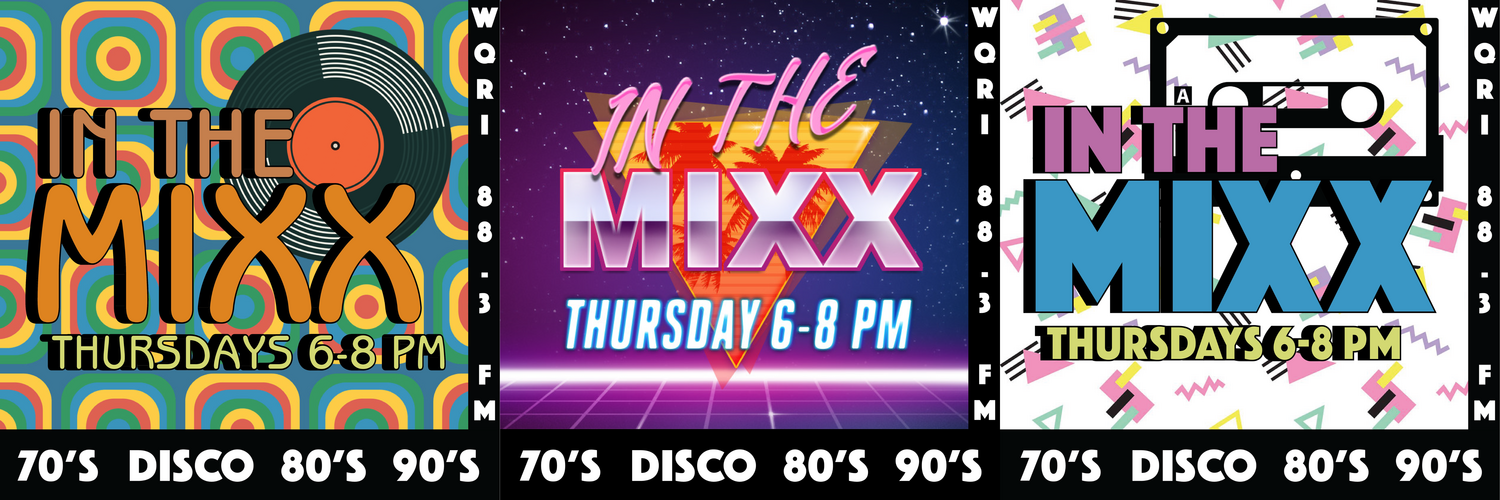
By graduate school, all of those experiments had evolved into In the Mixx.
It was his favorite.
The show moved freely through the 1960s, ’70s, ’80s and ’90s, with disco still at its heart. Belmonte would sometimes arrive early and put on smooth jazz before his official start time – artists such as Kenny G, Pat Metheny, 3rd Force and The Rippingtons – an echo of the idea behind his very first show.
For two hours, the architecture deadlines could stay outside the booth.
“It was kind of an escape. It was two hours that were mine to play my own music. It didn’t matter if anybody was listening or not. I was putting myself out there and saying, ‘This is the music I like. Listen to it or don’t. But I worked hard on this playlist, and I’m going to play it for you guys.’”
People were listening.
Friends tuned in every week. Professors listened. Belmonte became friendly with Commons employees who would put his show on while he was broadcasting. Shuttle driver Jane Walker would text him to ask when he would be on so she could tune WQRI in for passengers.
That connection gave radio something a playlist alone could not provide.
When one of his friends struggled to name a song he wanted Belmonte to play, he eventually told him, “Usually, whatever you play, I like.”
For Belmonte, that was the personal side of college radio: listeners were not simply hearing a DJ. They were hearing somebody they knew – and sometimes discovering another side of that person in the process.
Behind the Music
As much as Belmonte loved being on the air, some of his most significant contributions happened where listeners could not see them.
He became co-programming director alongside Doc Chicarelli during a period of technological change for WQRI. Chicarelli took a leading role in moving the station’s automated programming from Spotify to WideOrbit, while Belmonte gravitated toward equipment, computer systems, live-event units and the physical operation of the booth.
It suited his curiosity.
Even when he was a new DJ, Belmonte wondered what was underneath the sliders on the soundboard, how the signal traveled from the Recreation Center to the antenna and what all the wiring behind the equipment actually did.
As programming director, he finally had the opportunity to find out.
He reorganized the small production room outside the booth, clearing years of accumulated equipment and storage so it could function again as a workspace. He helped maintain WQRI’s live units for campus events. Obsolete CD equipment came out. New technology went in. The station eventually installed a new mixing board.
Then came the transmitter.
In 2019, WQRI engineer Dave Doherty determined that the station’s aging transmitter was nearing the end of its usable life. Installed in 2001, it had already lasted far beyond its expected lifespan. Its performance was declining, repairs were becoming increasingly difficult, and losing the ability to broadcast for an extended period could jeopardize WQRI’s ability to remain on the FM airwaves.
For Belmonte, the issue reduced to one sentence.
“Without the transmitter, there is no WQRI.”
Student Senate ultimately approved reserve funding for a replacement, ensuring that 88.3 FM could keep broadcasting. The new transmitter was dramatically smaller than the machine it replaced – the difference, Belmonte remembered, was like comparing “a basketball and a ping pong ball.”
But its significance was much larger.
At the time, Belmonte was focused on solving the problem in front of him. Looking back, he sees the transmitter as part of something bigger: the responsibility each generation of WQRI students takes on when it inherits the station.
“You don’t think of that when you’re in the moment. To think of yourself as part of something that kept the organization going – there’s kind of a pride in that.”
The satisfaction was rarely dramatic.
It was a DJ sitting down at the board and everything working. It was a student taking a live unit to an event and encountering no problems. It was equipment doing exactly what it was supposed to do.
“That’s the most rewarding part,” Belmonte said, “because you know you’ve done your job.”
An Education Beyond Architecture
For Belmonte, WQRI was never separate from his education at Roger Williams.
It complemented it.
Running a two-hour show taught him to manage time precisely. He learned how long a playlist needed to be, how much room to leave for speaking and how to finish exactly when the next program was scheduled to begin.
DJ Bootcamp and years of broadcasting strengthened his communication and public-speaking skills. Maintaining the station gave him hands-on experience with computers, wiring and technical systems.
Those lessons followed him into architecture.
Today, Belmonte works as a job captain at TMS Architects and Interiors in Portsmouth, N.H., helping develop designs for custom homes along the New Hampshire coast and Lakes Region. His interest in technology has followed him into the workplace as well, where he has assisted with IT equipment, computer systems, servers and cabling.
“Those skills have transferred from school to real life. It makes you more desirable as an employee and just more talented as a person.”
That was part of what made WQRI valuable to him. It was not a classroom and did not have to resemble one.
Instead, it gave him responsibility.
Students were broadcasting over an FCC-licensed FM frequency. They had to know the rules. They had to operate equipment correctly. They had to fill airtime, solve problems and communicate with an audience.
And they could make mistakes.
“It wasn’t so much that it was like, ‘You’ve got to be great every time,’” Belmonte said. “It was like, ‘Be your best, and if you make a mistake, just hit the dump button and try again.’”
Building What Comes Next
Belmonte’s background makes him especially suited to imagine what WQRI could become next.
Asked what he would want to see in a future home for the station, the architect and former programming director immediately began designing.
A larger booth.
A separate production space where students could record sweepers, public service announcements and other material without interrupting a live show.
Room for producers to work alongside the person on air.
And outside the glass, something just as important: a gathering space with couches and enough room for students to stop, listen and connect with whoever is broadcasting.
That visibility matters to Belmonte because he remembers what happened when he first walked past WQRI himself.
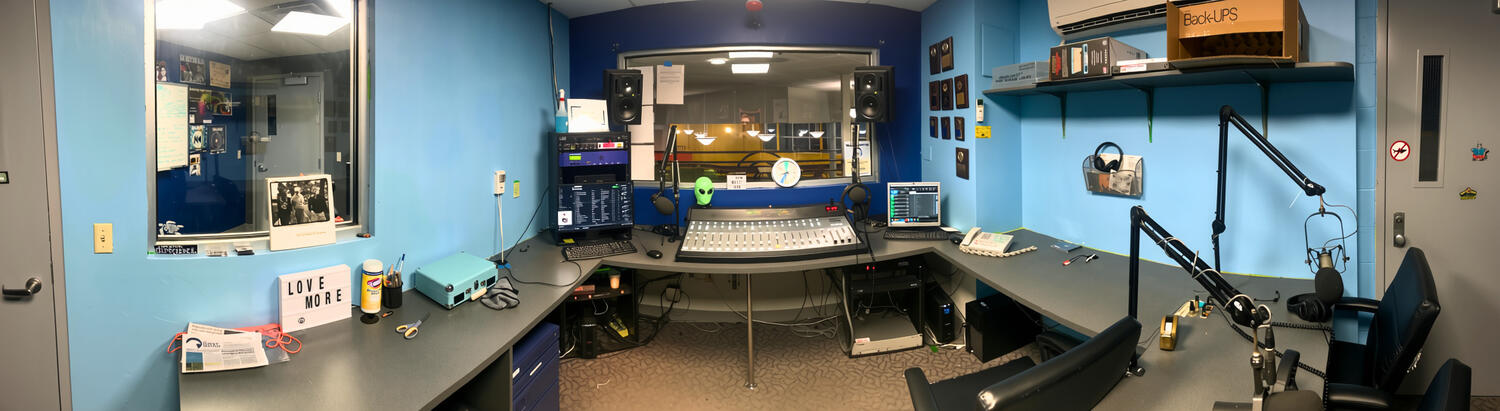
During some of his own shows, prospective students and their families would pass the booth during Open House. Belmonte would turn up the external speakers and watch to see whether anybody looked toward the glass.
Years earlier, he had been one of those prospective students.
“I knew that when I came to Roger for the first time, I was like, ‘I’ve got to do that,’” he said. “That was a big draw for me.”
A future WQRI space, in his mind, should preserve that invitation.
Because equipment will continue to change. Students will reorganize the booth. New generations will bring different music, different shows and different ideas. Belmonte wants that evolution.
He said he would be disappointed to return years later and find the station exactly as he left it.
What should remain is harder to replace.
“I hope WQRI never loses its energy and spirit. People didn’t just do a show because it was an option. They did it because they had a passion for it and they really wanted to do it.”
Belmonte still has reminders of those six years: paper-plate awards from WQRI gatherings, photographs and videos from inside the booth, even a decal salvaged from one of the old live units.
In his garage is a bin labeled “WQRI booth equipment,” filled with pieces removed during the station’s modernization.
And there is the music.
The first song of his first show.
The last song of his last.
After six years of changing programs, replacing equipment and helping WQRI prepare for whatever came next, Belmonte closed his time at 88.3 FM the same way he had begun it.
With Tavares. “Don’t Take Away the Music.”
Chris Belmonte's Five Songs
- Tavares – “Don’t Take Away the Music”
The first song Belmonte played during his first year at WQRI – and the final song he played at the end of his sixth. - Donna Summer – “On the Radio”
One of Belmonte’s favorites, with a title particularly well suited to six years behind the microphone. - Stevie Wonder – “Superwoman (Where Were You When I Needed You)”
Belmonte first heard the song in a music class at RWU and liked it enough that it became a regular part of his broadcasts. - Marcus Miller – “Red Baron”
One of the first songs Belmonte heard during his first visit inside the booth at DJ Bootcamp. Hearing it still takes him back to WQRI. - The Rippingtons – “Destiny”
During his fifth and sixth years, Belmonte often arrived early and eased into In the Mixx with smooth jazz before his show officially began. “Destiny” became one of his favorites for those moments.