
Small Shellfish, Big Questions: Roger Williams University Blue Fellows Study Hard Clam Survival and Growth
Through the Blue Fellows Program, two RWU students gained hands-on research experience at the Gulf Shellfish Institute while studying hard clam survival, growth, and aquaculture.
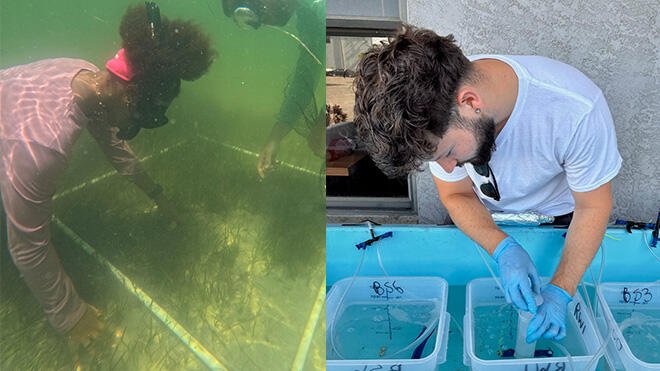
PALMETTO, Fla. – Roger Williams University (RWU) Blue Fellows Branalysa Varela ’26 and Noah Curtin ’27 spent the summer studying different questions about the same species: how hard clams survive in the field and how they grow in an aquaculture system.
Through the RWU Blue Fellows Program, Varela and Curtin conducted independent research at the Gulf Shellfish Institute (GSI) in Palmetto, Fla., where they focused on the ecologically and economically important hard clam species, Mercenaria. Varela investigated environmental factors that influence hard clam survival in wild ecosystems. She tested methods researchers use to track clams in their natural habitats to determine which provide the most accurate assessment of wild clam populations. Curtin examined the same clam species in laboratory trials to identify diets that best support juvenile clams in controlled settings. Throughout the summer, he monitored the clams’ growth rates, feeding behavior, and ability to filter water.
Learning to Adapt in the Field
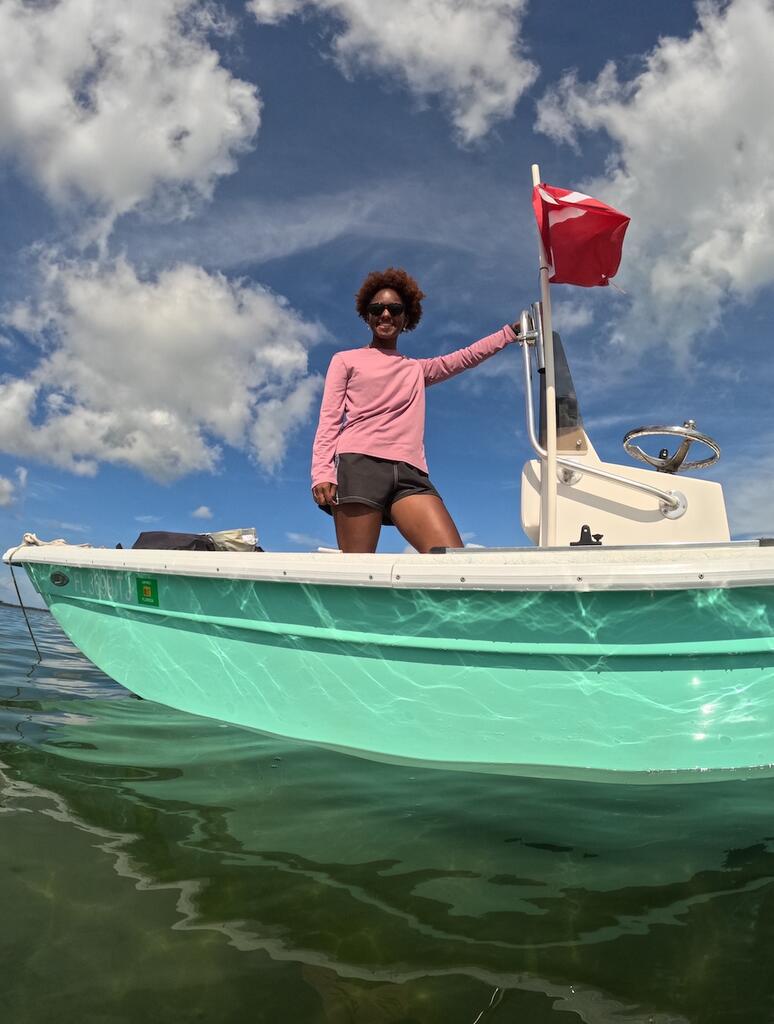
For Varela, a 2026 RWU graduate from Taunton, Mass., who majored in Marine Biology and Environmental Science and minored in Mathematics, the fellowship expanded her interest in hands-on marine research, something in which she had already engaged during her undergraduate years at RWU.
At GSI, Varela studied whether the presence of seagrasses influences hard clam survival. She tested methods for clam growth to identify approaches that best support hard clam restoration along the Florida Gulf Coast. She also assessed the effectiveness of passive integrated transponder (PIT) tags for tracking clam populations in the field.
Her work will help GSI identify effective methods for monitoring hard clam populations and collecting long-term data on their survival and behavior.
Varela also gained experience beyond her independent project. She contributed to GSI’s collaborative research projects with Florida’s Mote Marine Laboratory and the University of South Florida.
"One of the biggest lessons I will take from this fellowship is the importance of adaptability," Varela said. "Field research does not always go exactly as planned, so it is valuable to know how to step back, evaluate the situation, and make adjustments."
Varela will pursue a Master of Marine and Environmental Science degree at the University of the Virgin Islands, where she will work in a mangrove restoration lab. She hopes to build a career in marine conservation and restoration.
Exploring What Helps Hard Clams Grow
While Varela studied hard clam survival and field research methods, Curtin tested the performance of a product under development by RWU researchers.
Curtin, a rising senior from Lakeville, Mass., who is majoring in Biology, tested live algal feed concentrate, a product developed by researchers at RWU’s Center for Economic and Environmental Development (CEED), to examine its effects on juvenile hard clam growth, feeding behavior, and ability to filter water.
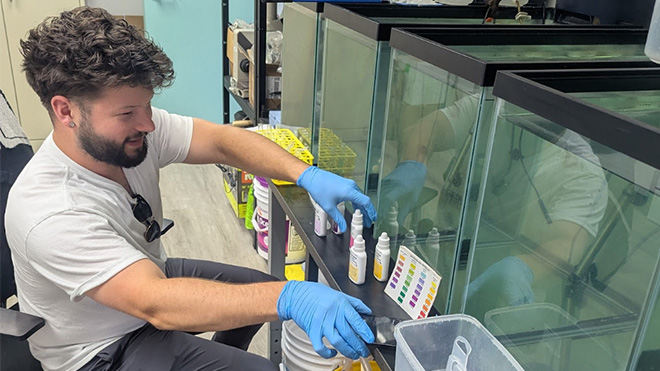
Over the course of the four-week experiment, he found that diet had a significant effect on juvenile hard clam growth and performance. While fresh live algae consistently outperformed all feeds and supported the greatest growth, the RWU algal concentrate performed better than a commercial shellfish diet product in several measurements.
The results will help CEED researchers refine the algal concentrate as a potential cost-effective, sustainable, and efficient feed for shellfish aquaculture.
"I was surprised to see how much the clams were able to grow in such a short amount of time since we were only able to run the experiment for four weeks," Curtin said.
Curtin also valued taking ownership of his research.
"The highlight of my fellowship was designing and carrying out my own research project from start to finish," Curtin said. "It was so rewarding to put together my work from throughout the summer into a final research presentation."
Although Curtin plans to pursue veterinary school after graduating from RWU, the fellowship showed him another way scientific research can contribute to animal health and conservation. He said it also strengthened his laboratory, research, and data analysis skills while building his confidence in communicating scientific findings.
Different Paths, Shared Experience
While Varela and Curtin came to GSI with different goals, both projects gave them something in common: the opportunity to follow their own questions and experience the research process, enabling them to grow as researchers and thinkers. Together, they found that studying one species can contribute to a broader understanding of marine life.
About the Blue Fellows Program
The Roger Williams University Blue Fellows Program, part of the Blue Solutions Institute at RWU, offers students immersive, hands-on internships with faculty researchers and industry leaders. The program is supported by a generous gift from Elizabeth Moore, a conservationist and environmental philanthropist, and a 2024 RWU honorary degree recipient. Read more about the fellows and their work in the RWU Blue Fellows Spotlight Series.
Blue Fellows Program