
Tiny Algae, Big Possibilities: Roger Williams University Blue Fellows Study Marine Algae as a Solution for Heavy Metal Pollution
Through the Blue Fellows Program, two RWU students are studying whether microscopic marine algae could one day help reduce heavy metal pollution in aquatic environments.
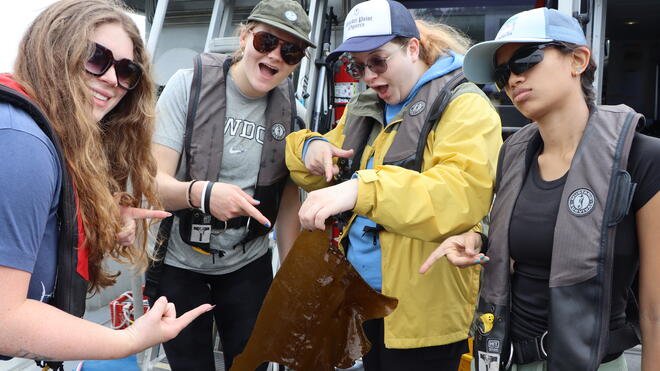
BRISTOL, R.I. – Could marine algae help reduce heavy metal pollution? Roger Williams University (RWU) Blue Fellows Keegan Denahey ’26 and Haley Kirkpatrick ’28 are spending the summer studying whether these microscopic organisms could eventually play a role in bioremediation, the use of living organisms to help remove pollutants from the environment.
Working at Bigelow Laboratory Provasoli-Guillard National Center for Marine Algae and Microbiota through the Blue Fellows Program at RWU's Center for Economic and Environmental Development (CEED), the students are researching how a marine diatom called Halamphora responds to heavy metals. Their work could help scientists better understand how these microscopic organisms might contribute to future bioremediation efforts of metal-contaminated sites.
Bigelow Laboratory, an ocean science research institution, partners with CEED to give RWU students the opportunity to conduct research alongside Bigelow scientists.
Looking to Nature for Answers
Heavy metals can accumulate in rivers, lakes and oceans through industrial activity and other sources, posing long-term risks to aquatic ecosystems. While researchers have explored several ways to reduce that pollution, many existing methods can be costly or difficult to implement.
Denahey and Kirkpatrick are studying two cultures of Halamphora and their naturally associated bacteria. They want to understand how these organisms tolerate heavy metals. By understanding how the algae tolerate these contaminated environments, researchers hope to learn how to apply these organisms’ unique capabilities to bioremediation.
Turning Curiosity Into Discovery
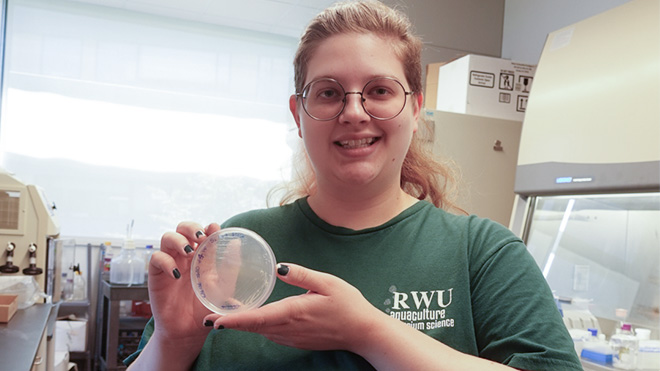
For Denahey, a senior from Des Moines, Iowa, majoring in Marine Biology and Applied Mathematics, the research builds on an interest that began in childhood.
"I became interested in marine biology after seeing my school district's Wet Lab when I was 7," Denahey said. "I'm super excited to be working with Bigelow Labs, which is the primary repository and keeper of microalgae in the United States."
After studying marine microalgae for nearly five years, Denahey hopes to continue working with the organisms after graduation, whether at a hatchery or in the biofuels industry. They said the fellowship has expanded their laboratory experience while providing a closer look at how a professional research laboratory operates.
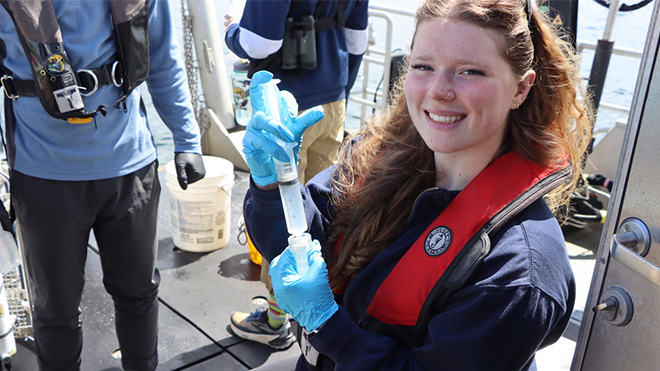
Kirkpatrick, a rising junior from Bath, Maine, majoring in Marine Biology, was drawn to the fellowship by her interest in marine science and the opportunity to gain hands-on research experience.
"My main goal of becoming a RWU Blue Fellow was driven by my love of being outside," Kirkpatrick said. "Being a RWU Blue Fellow this summer is giving me the opportunity to work in a research lab with others that share my similar interests of learning about science and to immerse myself in scientific research."
Kirkpatrick said the research could help scientists determine how to use Halamphora as a tool in reducing heavy metal pollution.
After graduating from RWU, Kirkpatrick plans to attend veterinary school. She said the fellowship is helping her develop laboratory techniques while strengthening communication, collaboration and professional networking skills.
"I am most excited to just be in the lab and doing research alongside senior researchers and experts within their field," Kirkpatrick said. "The mentors at Bigelow are extremely knowledgeable and are great teachers."
Preparing Future Scientists
Denahey and Kirkpatrick plan to pursue different careers after graduation. But both are gaining research experience while studying an important environmental challenge. Along the way, they are applying classroom learning in a professional laboratory while developing scientific and professional skills they can carry into their careers.
About the Blue Fellows Program
The Roger Williams University Blue Fellows Program, part of the Blue Solutions Institute at RWU, offers students immersive, hands-on internships with faculty researchers and industry leaders. The program is supported by a generous gift from Elizabeth Moore, a conservationist and environmental philanthropist and a 2024 RWU honorary degree recipient. Explore the RWU Blue Fellows Spotlight Series to learn more about the students and their research.
Blue Fellows Program