
Roger Williams University Blue Fellows Advance Aquaculture Research to Support Sustainable Fish Farming
Roger Williams University Blue Fellows Cara Harvey '26 and Gillian Frey '27 are conducting hands-on aquaculture research that could improve fish nutrition, prevent disease, and strengthen the blue economy.
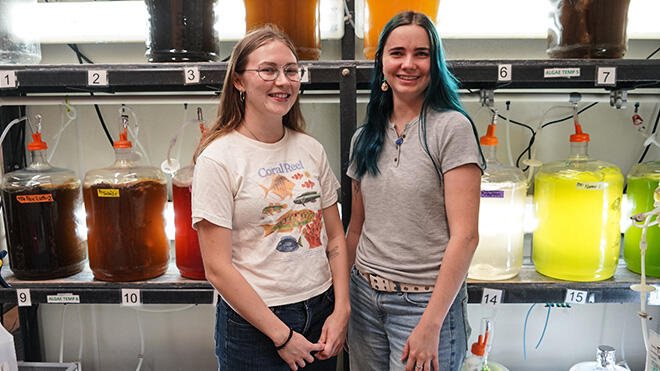
BRISTOL, R.I. – Roger Williams University students Cara Harvey '26 and Gillian Frey '27 are spending the summer conducting aquaculture research through RWU’s Blue Fellows Program at the Center for Economic and Environmental Development (CEED). Their projects aim to improve fish nutrition, reduce disease, and support more sustainable fish farming by improving the health and survival of larval fish raised in aquaculture systems.
Their research through the Blue Fellows Program advances CEED's mission of giving students real-world research experience while supporting innovation in aquaculture, marine science, and Rhode Island's growing blue economy.
Improving Nutrition for Larval Fish
After graduating in May with degrees in Marine Biology and Chemistry and a minor in Spanish, Harvey chose to continue the research she began during her senior capstone project.
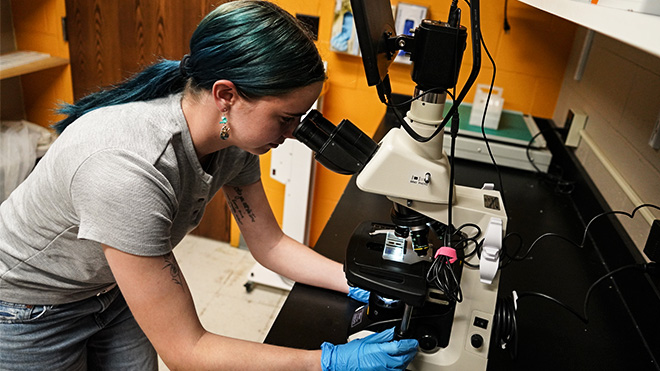
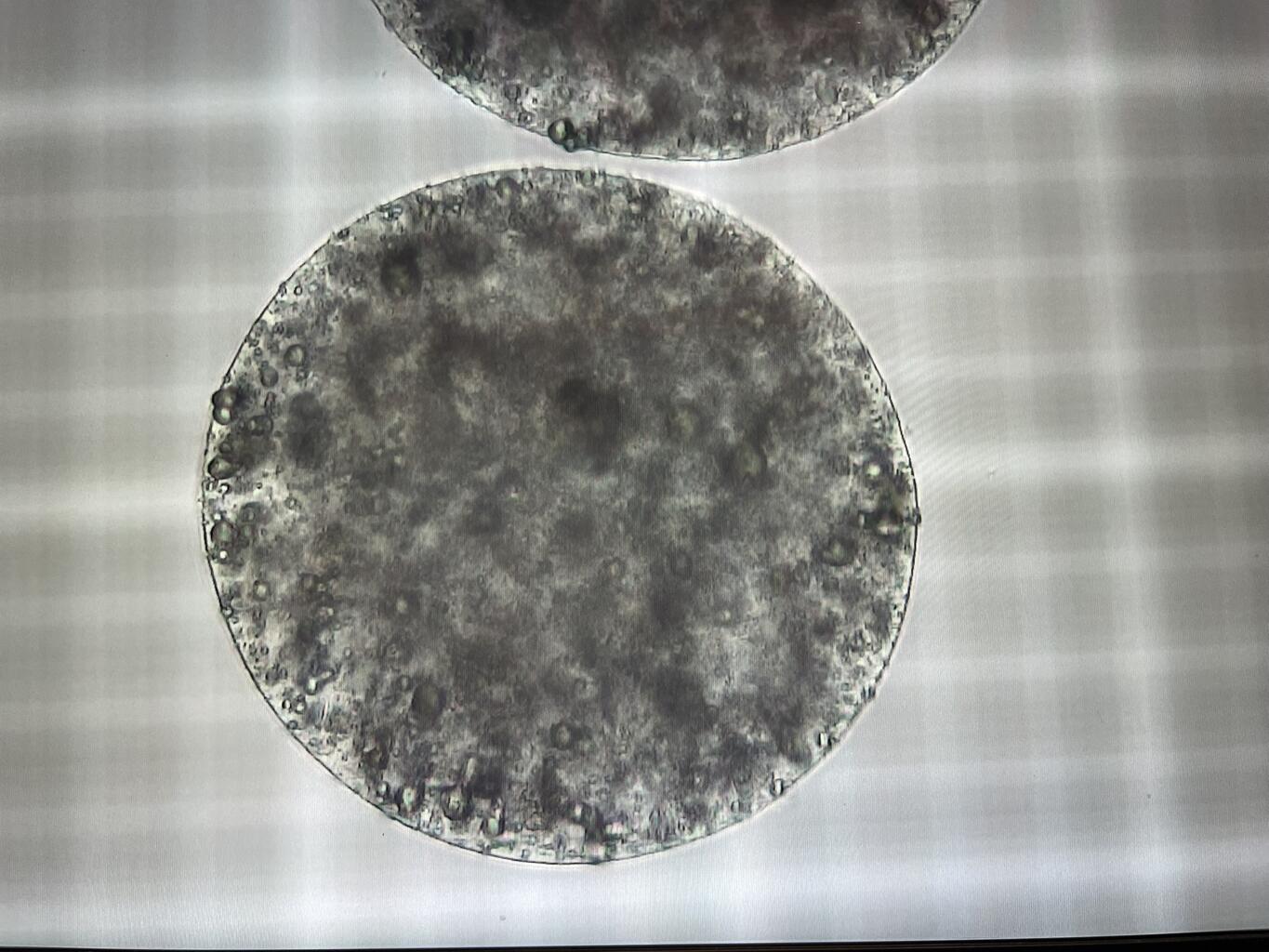
Working with Marine Biology Professor Andrew Rhyne in CEED’s Aquaculture and Aquarium Science Laboratory, she is developing tiny gel-like alginate spheres that could become a new food source for larval fish. Unlike traditional pellets, which are often too large for newly hatched fish, the spheres can be customized with nutrients such as algae, fish oil, liquid enrichment, and crushed pellets.
"The RWU Blue Fellows Program allows me to continue the research I started, expanding my work in hopes that it can be implemented on campus,” said Harvey, from Fishers, Ind. “It lets me continue my education and research outside of my undergraduate education before deciding what to do next."
Harvey hopes the new food will improve larval fish nutrition while reducing food waste in RWU's wet lab. Less wasted food can improve water quality, reduce stress and disease, and decrease the time needed to clean tanks. Creating food that can be customized for different species could also improve fish survival and support future aquaculture research.
Throughout the summer, Harvey is refining the manufacturing process to produce more consistent spheres and plans to test them with shrimp and, eventually, larval fish.
Harvey said the fellowship is preparing her for graduate school by strengthening her independent research skills and giving her hands-on experience with laboratory techniques that can be applied to larger-scale projects.
Researching New Ways to Prevent Disease
While Harvey focuses on fish nutrition, Frey is studying how beneficial bacteria could help prevent disease in aquaculture systems.
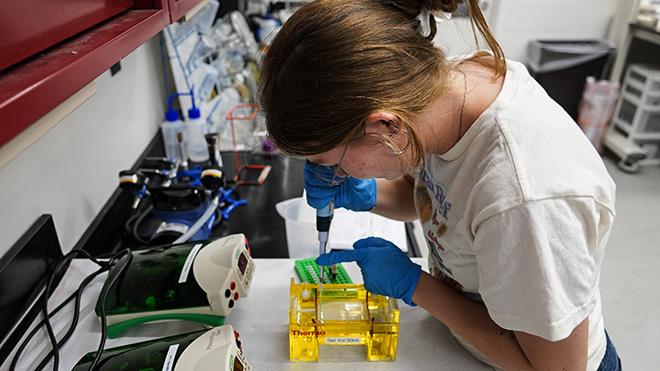
A rising senior from Milwaukee majoring in Marine Biology with a minor in Visual Arts, Frey is working in CEED's Aquaculture and Aquarium Science Laboratory with Professor Andrew Rhyne and the Coral Microbiology Laboratory with Associate Professor of Marine Biology and CEED Director Koty Sharp. She is studying how beneficial bacteria isolated in the lab at RWU affect copepods, tiny crustaceans that are an important food source for larval fish.
Previous research at Roger Williams University identified certain bacteria that can protect corals and oysters from harmful bacteria such as Vibrio. Frey is now exploring whether those beneficial bacteria could also reduce disease outbreaks in copepod cultures used in aquaculture.
If successful, the research could help protect copepod populations, reduce losses caused by disease, and improve the health of larval fish raised in aquaculture systems.
Like Harvey, Frey plans to continue her education after graduation. Through the Blue Fellows Program, she is gaining experience designing experiments and learning microbiology and biotechnology laboratory techniques that will prepare her for graduate research.
"I plan to go to grad school to pursue a master's in Marine Biology," she said. "This fellowship is preparing me by giving me more experience in a lab setting, specifically applying tools of microbiology to marine science."
Preparing Future Marine Scientists
The Blue Fellows Program gives Roger Williams University students opportunities to work alongside faculty mentors on research addressing real-world challenges facing ocean and coastal communities. For Harvey and Frey, the experience is strengthening their laboratory skills while preparing them for graduate school and careers in marine science, aquaculture, and Rhode Island's growing blue economy. Together, their research demonstrates how RWU students are advancing innovations that support sustainable aquaculture and the future of blue biotechnology.
About the Blue Fellows Program
The Roger Williams University Blue Fellows Program, part of the Blue Solutions Institute at RWU, offers students immersive, hands-on internships with faculty researchers and industry leaders. The program is supported by a generous gift from Elizabeth Moore, a conservationist and environmental philanthropist and a 2024 RWU honorary degree recipient. Read more about the fellows and their work in our RWU Blue Fellows Spotlight Series.
Blue Fellows Program