
WHM Spotlight: June Speakman
Professor of Politics and International Relations and Rhode Island State Representative June Speakman reflects on leadership in the classroom, community, and state government.
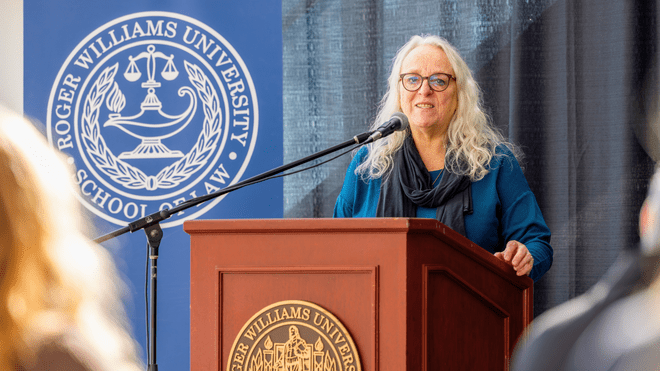
To continue our celebration of Women’s History Month and the remarkable women who help shape the Roger Williams University community, we’re introducing you to June Speakman, Professor of Politics and International Relations and State Representative for Rhode Island’s District 68, representing Bristol and Warren.
Speakman has been a member of the RWU faculty since 1995, teaching courses in American politics, state and local government, and public policy. Over the past three decades, she has served in numerous leadership roles at the university, including department chair, Faculty Senate president, and president of the RWU Faculty Association.
Her academic work also extends into research on American political institutions and public policy. Speakman has written on topics including congressional voting behavior, women in politics, and municipal governance, exploring how political systems shape decision-making at both national and local levels.
Beyond the classroom, Speakman has built a distinguished career in public service. She was elected to the Rhode Island House of Representatives in a special election in 2019 and now represents District 68 in Bristol and Warren. In the General Assembly, she serves as second vice chair of the Municipal Government and Housing Committee and sits on several committees focused on oversight, environmental policy, and health and human services.
A leading advocate for housing policy, Speakman chairs the House Commission on Housing Affordability and has sponsored legislation aimed at expanding housing supply and affordability across Rhode Island. Her work has included measures to establish a permanent funding stream for affordable housing, encourage accessory dwelling units, and support new housing development strategies statewide.
“My teaching enriches my service, and my service informs my teaching. I have found that my students benefit from the practical experience that I have in the real world of politics and policy-making. I can bring stories to class and provide real-world examples of what they’re reading in their books."
Before joining RWU, Speakman taught at Rutgers University and the Claremont Colleges. She holds a Ph.D. in Political Science from the City University of New York, a master’s degree in Economics from the New School for Social Research, and a bachelor’s degree in Economics from the University of Massachusetts Amherst.
Fun Facts About June
- She is the mother of two adult sons, Jason and Adam, and shares her home in Warren with their dog, Cooper.
- She admits to having an irrational fear of flying.
- She also has what she calls an “irrational affection” for the Boston Red Sox, even if she doesn’t always know who is on the roster.
In Her Own Words
Tell us about your role at RWU and what leadership looks like in your work.
I have been on the faculty at RWU for 30 years. During that time, I have served as department chair, Faculty Senate president, RWUFA president, chaired several committees, and served on many others. I have also served my community as a member of the Barrington Town Council for 14 years and now as a member of the Rhode Island House of Representatives since 2019 representing Bristol and Warren.
Leadership for me has meant participating in the governance of the university while also engaging in public service in the broader community.
What does it mean to you to be a woman leader in higher education and state government?
I think it’s important for there to be diversity of life experiences and perspectives in all leadership positions, including at the university and in government. I have observed that women often – though not always – bring a somewhat different approach to leadership that can be more collaborative and inclusive, which can help organizations make better decisions. Of course, those are generalizations, but having a range of perspectives around the table strengthens decision-making.
What does “Give to Gain” mean to you and what do you give that helps others gain opportunity?
As a teacher, it’s really about giving students the analytical and critical thinking skills they need to succeed in their professional lives. One of my former students is currently pursuing a Ph.D. and has just published his first academic article. Seeing that kind of success grow out of the work students begin in our department is extraordinarily gratifying.
In my work in the General Assembly, I try – along with my colleagues – to move Rhode Island toward a place where residents can find housing, rely on clean energy, and have access to affordable, high-quality healthcare. It’s always a collective effort, but I hope that I contribute something toward making those goals a reality.
Were there specific people who helped shape your path, and how did their influence guide you?
When I first came to RWU in 1995, there were not many women on the faculty, and I was the only woman in my department at the time.
Professor Deborah Robinson, who taught English literature here for many years, was an important role model for me on how to have your voice heard at the table. She exercised leadership in a calm, forceful way and always with a sense of humor.
Many women of my generation also entered politics through involvement in their children’s schools. That was certainly my path, though fortunately today younger women have many more avenues into political leadership.
What has been one meaningful success in your work with RWU?
When I arrived at RWU, there were only two politics faculty members. At our peak a few years ago, we had eight. Helping build that department and seeing students thrive in the major – and then go on to fulfilling careers – has been very meaningful.
More recently, participating in the team that helped guide the university through the COVID pandemic – from the shutdown through the reopening – was an example of what collaborative leadership can accomplish. It was a university-wide effort, and I’m proud to have been part of it.
When you reflect on the journey that brought you to RWU, what experiences most prepared you for the work you’re doing now?
Since my undergraduate days, I have been on the academic path. The political path, however, was not something I expected.
I never imagined myself running for office, but the local Democratic Party asked me to run, which came as a surprise. So in many ways, nothing in my earlier life specifically prepared me for it – and I continue to learn something new every day in that role.
What advice would you offer to students or early-career professionals stepping into leadership?
Do something you love – you’ll likely be doing it for a long time.
Make room in your life for kids and dogs. Ask for help when you need it, and always acknowledge the people who have provided that help and guidance along the way.
Women's History Month Spotlights 2026