
Timothy O’Hara Strengthens a Career in Law Enforcement Through Graduate Study at RWU
After more than 30 years with the Providence Police Department, the deputy chief is pursuing a master’s degree to deepen his understanding of modern policing.
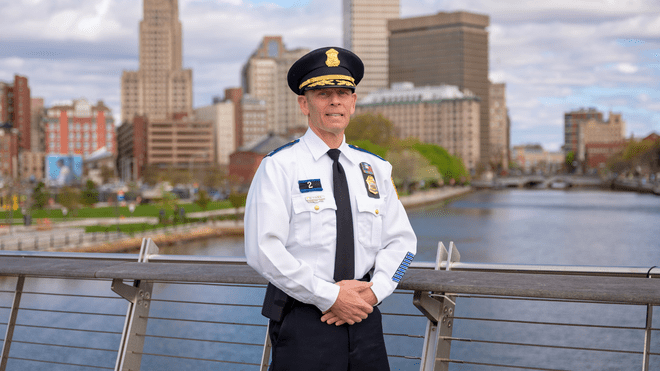
PROVIDENCE, R.I. — For Timothy “Tim” O’Hara, pursuing a Master of Science in Criminal Justice at Roger Williams University was not a departure from his career in law enforcement, but an extension of it.
Now serving as Deputy Chief of Police in Providence after more than 30 years with the department, O’Hara enrolled in the graduate program with a clear purpose: to broaden his understanding of a profession he has spent decades practicing.
“It gave me the opportunity to think more critically about issues beyond the immediate responsibilities of the job,” O’Hara said. “Policing is one part of a much larger system. Being able to look at things from the perspective of courts, attorneys, and the broader justice system really opened my mind.”
That perspective did not come from coursework alone. In discussions with classmates – many from different generations and backgrounds – O’Hara encountered viewpoints that challenged and expanded his own.
“It was important to hear what people think about the system today – what they think is fair or unfair, what they think needs to change,” he said. “That kind of feedback is important for me in my profession. You don’t always get that in your day-to-day work.”
Balancing graduate coursework with the demands of senior leadership required discipline, particularly while managing a full-time role and other responsibilities.
“It’s not easy,” he said. “There are a lot of people working full-time, raising families, and still pursuing their degrees. I was doing it while working and serving on the parole board. It definitely gives you an appreciation for what students are managing.”
A Career Built Through Experience
O’Hara’s path into law enforcement was not immediate. A native of East Providence, R.I., he spent his early career working a range of jobs, including as a photographer covering weddings and local news. It was through a close friend, Robert Lepre, that he began to seriously consider the profession.
At the time, Lepre, who earned a Bachelor of Science in Administration of Justice from RWU in 1992, was already serving as a Providence police officer. He offered O’Hara a firsthand look at the realities of the job and encouraged him to pursue it.
“I always had an interest, but talking with him and seeing what the job was like definitely influenced me,” O’Hara said.
O’Hara joined the Providence Police Department at 30, initially focused on becoming a detective.
“I always wanted to learn as much as I could where I was,” O’Hara said. “Once I felt like I had learned enough, I thought maybe I was ready to try for the next level.”
That approach has defined his career. Over three decades, he has served in roles across the department, including the Gang Unit, Violent Crime Task Force, and Patrol Bureau, and previously led the Detective Bureau. He has worked on and supervised 95 homicide investigations – cases that, he said, reinforce the weight of the work.
“That means there are that many families who lost someone,” he said. “They went out one day, said goodbye to a loved one, and never saw them again. It’s important to remember that. They deserve answers, and that’s what drives you to keep working.”
His leadership style reflects the same steady progression. Having worked through each rank, O’Hara emphasizes accountability, consistency, and leading by example.
“I like to be able to say I’ve been there,” he said. “I’ve worked the night shifts, I’ve done those assignments. I’m asking people to do things that I’ve already done myself, and I think that’s important in building trust.”
He also prioritizes direct engagement with officers, regularly reviewing reports and recognizing strong performance.
“I read a lot of reports, so I have a good sense of what’s happening day to day,” he said. “If I see someone did a good job on a call or handled something well, I’ll mention it to them. Just letting people know their work is being noticed and appreciated goes a long way.”
Learning, Leading, and Looking Ahead
Over the course of his career, O’Hara has seen policing evolve significantly, particularly in areas of transparency, community engagement, and technology.
“We’re much more connected to the community now,” he said. “We’re more transparent, and we’re always trying to show people that we’re respectful and compassionate in how we do the job.”
In Providence, those changes include the integration of mental health professionals into daily operations and the development of a real-time crime center that provides officers with critical information as they respond to calls.
“That’s really the next wave of policing,” O’Hara said. “Being able to give officers real-time information – what’s happened at an address before, who might be involved, what they should be aware of – it helps them respond more effectively and safely, and it can even help with de-escalation.”
His graduate studies have complemented that evolution, reinforcing the importance of considering multiple perspectives when evaluating policy and practice.
“You have to listen to other points of view,” he said. “Sometimes there isn’t a clear right or wrong answer, but understanding where other people are coming from helps you make better decisions and find common ground.”
For O’Hara, that intersection of experience and continued learning defines both his present and his future.
“I just want to be helpful,” he said. “If I can give someone direction or encourage them to be successful, that’s how I measure success.”
After more than three decades in law enforcement, it is a perspective shaped not only by experience, but by a continued commitment to learning – one that remains central to how he leads today.
2026 Graduate Blog