
Lia Franciszkiewicz Explores Architecture Through an Interdisciplinary Lens at RWU
Senior integrates architecture, sustainability, and art history to shape a community-focused approach to design.
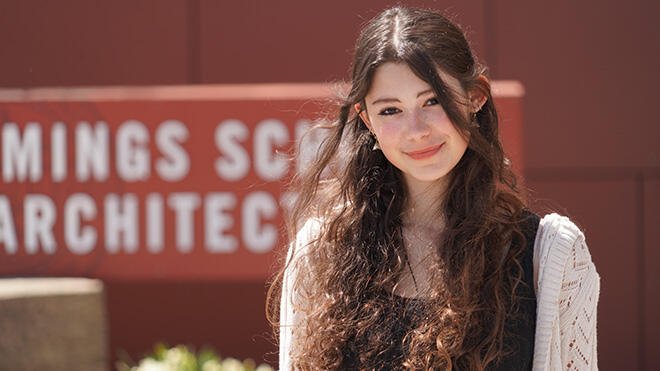
BRISTOL, R.I. – For Lia Franciszkiewicz, architecture has never been just about buildings – it’s about understanding how design connects people, place, and purpose.
A senior Architecture major from Old Saybrook, Conn., Franciszkiewicz has built an interdisciplinary academic path at Roger Williams University, combining her studies with minors in Sustainability Studies and Art & Architectural History. Together, those fields have shaped a broader perspective on design – one grounded in both creativity and context.
From the outset, she was drawn to RWU for the strength of its Architecture program and the flexibility to explore coursework across disciplines. That freedom allowed her to refine her interests and develop a more holistic understanding of the field.
Her interest in architecture began with its dual nature, blending creative thinking with academic rigor.
“It’s a creative process integrated within the academics,” she said.
Franciszkiewicz credits the Honors Program with helping establish that interdisciplinary mindset early in her college experience. A formative course, Honors 140: Systems Thinking, introduced her to problem-solving across disciplines – an approach she continues to apply in her studio work.
“I’m really grateful to have had the opportunity to start there,” she said. “As I took more classes in my major and outside of my major, I was able to absorb the information in a way that I could apply it to my studio projects.”
Beyond the classroom, she has expanded her skill set as a writing tutor in the RWU Tutoring Center, helping peers strengthen their communication while refining her own.
Her interdisciplinary approach is especially evident in her sustainability work. In her capstone course, Sustainability Studies 401: A New Life for Campus Clothing, Franciszkiewicz collaborated with the Sustainability Club to support the development of an on-campus thrift initiative.

Her group’s project focused on reducing waste, increasing access to affordable clothing, and raising awareness about the environmental impact of fast fashion. As part of the effort, the team installed donation boxes across campus and hosted a pop-up thrift event in collaboration with local community partners.
“That was definitely bringing some of my design and problem-solving knowledge from my major and applying it to something that was outside of myself,” she said. “It reinforced my community-based values.”
The experience also deepened her understanding of how sustainable initiatives take shape.
“Not just looking at the end solution, but everything in between – and some of the more complicated sides of implementing sustainable action,” she said.
That perspective continues to inform her architectural work. In a recent project based on a precedent from Japan, Franciszkiewicz explored traditional and global passive cooling strategies, integrating her sustainability studies into her design process. She is continuing that work in a graduate-level Construction Materials and Assemblies course, developing detailed façade systems.
She is also applying her work to real-world challenges. Her advanced studio project serves as a submission to the ACSA 2026 Design for Aging Competition, addressing social isolation through intergenerational housing concepts that bring together seniors and students. The project also considers the I-195 redevelopment in Providence, requiring her to engage with real stakeholders and site conditions.
“I think throughout undergrad, I’ve learned that I need to touch on everything,” she said. “A big part of architecture goes beyond the creative design process.”
Rather than focusing narrowly, Franciszkiewicz has embraced a broad, interdisciplinary approach – one that allows her to engage with the social, environmental, and cultural dimensions of design.
She credits her professors, many of whom are practicing architects, with helping shape that perspective. Among those who influenced her most are Professor Junko Yamamoto, Professor Ginette Castro, and Professor John Hendrix, whose courses helped her connect design with cultural and historical context.
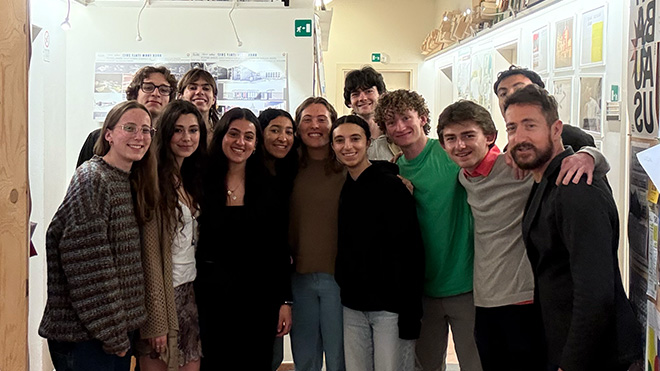
Her work has been recognized with several scholarships, including the Norton E. Salk Scholarship from the AIARI Architectural Forum, the Zachary Shapiro Study Abroad Scholarship, and two DePaola Family scholarships.
That support made possible her study abroad experience in Florence, Italy, during the spring of her junior year. While there, she studied European urban design and observed how cities prioritize walkability and human-centered spaces.
“Coming back with that perspective of designing for the everyday human experience is something I want to carry forward,” she said. “It really helped solidify my goals in architecture.”
After graduation, Franciszkiewicz plans to pursue a graduate degree in architecture, focusing on sustainable and user-centered design. She is considering continuing her studies at RWU, building on the advanced coursework she has already begun.
2026 Graduate Blog