
WHM Spotlight: Joanna Ravello Goods
Vice President for Equity and Inclusion and Chief Diversity Officer Joanna Ravello Goods reflects on leadership, belonging, and amplifying voices across the RWU community.
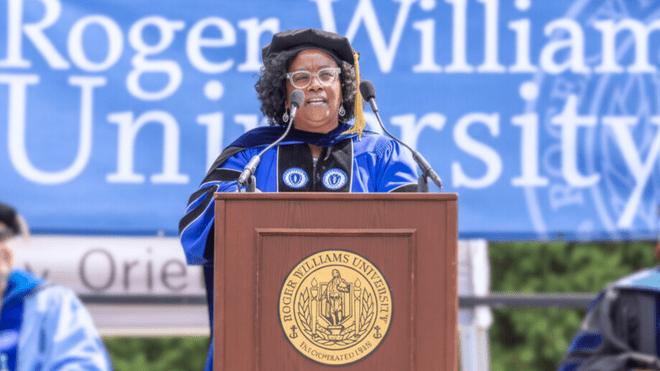
To continue our celebration of Women’s History Month and the remarkable women who help shape the Roger Williams University community, we’re introducing you to Joanna Ravello Goods, Vice President for Equity and Inclusion and Chief Diversity Officer.
As a member of the President’s Cabinet, Ravello Goods leads the university’s efforts to advance diversity, equity, and inclusion across RWU’s Bristol and Providence campuses. In this role, she works closely with students, faculty, staff, and community partners to help implement the university’s Equity Action Plan and ensure that institutional practices, programs, and policies reflect RWU’s commitment to building an anti-racist, diverse, and inclusive community.
Ravello Goods brings more than 15 years of leadership experience in higher education to the role. Before joining RWU, she served as Associate Vice President for Diversity, Equity and Inclusion at Stonehill College, where she helped establish the institution’s Office of DEI and launched strategic initiatives and grant programs to strengthen campus engagement and culturally responsive programming.
Her career has also included leadership roles at the University of Rhode Island, where she directed community and organizational development initiatives focused on student success and institutional transformation. For nearly three decades, Ravello Goods has also served as an educator, teaching courses in Gender and Women’s Studies, Human Development, Higher Education, and Sociology, weaving themes of liberation theory and intersectionality into both scholarship and practice.
She holds a Ph.D. in Higher Education Administration from the University of Massachusetts Boston and both a master’s and bachelor’s degree in Human Development and Family Studies from the University of Rhode Island.
Fun Facts About Joanna
- She and her family immigrated to the United States from Trinidad and Tobago in 1979, settling in Providence, where she continues to live today.
- She was honored as the Trailblazer for Diversity & Inclusion Champion at the 2025 R.I.S.E. Women’s Leadership Conference.
- She is an avid art journal enthusiast, proud plant parent to more than 100 plants, and enjoys traveling and exploring new cuisines.
In Her Own Words
Tell us about your role at RWU and what leadership looks like in your work.
As Vice President for Equity and Inclusion and Chief Diversity Officer, my role has both strategic and community-facing dimensions. As a cabinet member, I help inform institutional conversations and decisions through the lens of equity, justice, and inclusion.
At the same time, my work involves engaging directly with the campus community. That might include developing educational programs and training opportunities, collaborating with student organizations, reviewing policies through an equity lens, or working with campus leaders to understand how broader policy changes affect our community.
There is really no typical day. I may be working with students on a concern, collaborating with colleagues on a campus initiative, or engaging with external partners and alumni. I see my leadership role as one centered on listening and amplifying voices that already exist within the community.
What does it mean to you to be a woman leader at RWU?
When I think about this question, I also think about my identity through an intersectional lens – as a Black woman, an immigrant, and a leader in higher education. Those experiences shape the way I approach my work and how I understand the many perspectives that exist within a community.
These intersections of identity give me what I often describe as different “angles of vision.” They remind me that people arrive at institutions with a range of experiences, backgrounds, and needs. Recognizing those differences – and valuing them – is essential to building a thriving community.
For me, leadership means creating spaces where people can express their voices and perspectives and where decision-makers are willing to listen and engage thoughtfully. When communities acknowledge and build upon the diversity of experiences within them, they become stronger and more vibrant.
What does “Give to Gain” mean to you, and what do you give that helps others gain opportunity?
Throughout my educational journey, there have been many moments where someone stepped in and helped guide me forward. Those moments shaped my understanding of what mentorship and support can look like.
When I first came to the United States as a young immigrant, I was navigating cultural differences and new systems. Later, in high school, one of my teachers, Kay “Katherine” Scheidler, encouraged me to apply to college even when I hadn’t planned to. That moment led me to the University of Rhode Island, where I entered the Talent Development program and received significant mentoring throughout my academic journey.
Because of those experiences, I try to be that person for others. Whether on campus or off campus, I want to create space for people to share their concerns, think through challenges, and recognize that difficult moments are often temporary. Giving someone time, listening, and encouragement can make a meaningful difference in how they see themselves and their opportunities.
Were there specific people who helped shape your path, and how did their influence guide you?
One mentor who has had a profound influence on my life is Dr. Angel Green, an English professor at the University of Rhode Island. Although she was never formally my professor, she noticed me one day in the office of the Talent Development program and began mentoring me from that point forward. She has supported me through job applications, graduate school decisions, and many life challenges.
Dr. Green is someone who challenged my thinking constantly. She pushed me to question assumptions and move beyond self-doubt. That mentorship helped me develop the confidence to pursue opportunities I might not otherwise have considered.
What has been one meaningful success in your work with RWU?
One initiative that has been especially meaningful to me is the campaign we launched called “Community Starts With Me, Thrives With Us.”
During my first semester at RWU, I spent time meeting with trustees, cabinet members, and employees across the university. But it was when I began speaking with student affinity groups and student organizations that I truly felt connected to the campus. Listening to students helped me better understand how they experience RWU and what they hope the community can become. Many of the ideas that shaped the campaign came directly from those conversations.
The initiative now includes several programs focused on student engagement, employee engagement, and building stronger connections across the university. At its core, it reflects a simple idea: a thriving community begins when everyone sees themselves as part of creating it.
When you reflect on the journey that brought you to RWU, what experiences most prepared you for the work you’re doing now?
Many of the identities I hold – being a woman, being Black, being an immigrant – have shaped how I approach my work and how I understand the challenges people may face in institutions.
Professionally, my career has developed through progressive roles in student support, advising, training, and organizational development. I have worked with first-generation students, students of color, single parents, and many others navigating complex pathways through higher education.
Those experiences helped me understand how institutions can either support or hinder student success. They also helped prepare me to work collaboratively with faculty, staff, and administrators who want to strengthen their practices and create more inclusive environments.
What advice would you offer to students or early-career professionals stepping into leadership?
Try the thing. Sometimes we hesitate because we feel we need to be fully ready before taking on a new opportunity. But readiness is not just a feeling – it comes through action.
My advice is to trust your abilities, take the step forward, and allow yourself to grow through the experience. Leadership often begins simply by deciding to try.
Women's History Month Spotlights 2026