
WHM Spotlight: Hume Johnson
Associate Professor Hume Johnson explores personal branding and global identity through teaching, scholarship, and public engagement.
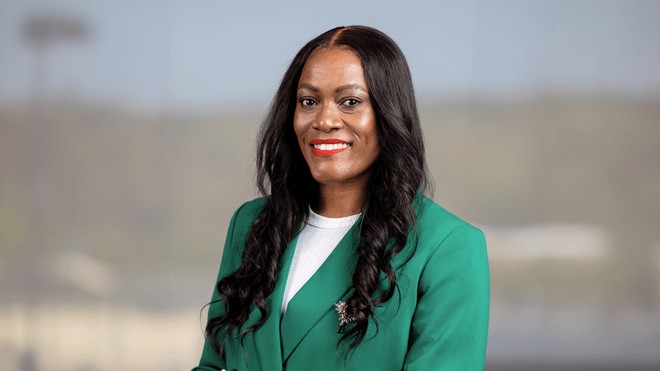
To continue our celebration of Women’s History Month and the remarkable women shaping the Roger Williams University community, we’re introducing Hume Johnson, Associate Professor of Organizational Communication and Media Studies, global leadership strategist, and author.
An interdisciplinary practitioner-scholar and public intellectual, Johnson’s work sits at the intersection of personal branding, leadership development, and global identity. A former broadcast journalist and political speechwriter for the Government of Jamaica, she brings more than two decades of experience in media, strategic communication, and public engagement into her teaching and scholarship.
At RWU, Johnson teaches courses in organizational communication, crisis communication, public speaking, and mass media. Across each course, she challenges students to understand and articulate their unique value – what she describes as developing a personal brand rooted not in visibility, but in clarity of identity, purpose, and impact.
Her scholarship explores how branding functions as a site of power, representation, and self-determination – from individuals navigating professional spaces to nations shaping their global image. Drawing on her Jamaican roots and global career, her work examines the tensions between identity, perception, and lived experience in an increasingly interconnected world.
A published author and global speaker, Johnson has contributed to leading academic journals and media outlets, and continues to engage audiences through leadership training, media commentary, and consulting work with organizations, executives, and emerging leaders.
Johnson holds a Ph.D. in Political Science and Public Policy from the University of Waikato in New Zealand, along with a master’s degree in International Relations and a bachelor’s degree in Media and Communication from the University of the West Indies in Jamaica.
Fun Facts About Hume
- Early in her career, she stepped away from a traditional 9-to-5 to pursue freelance work, seeking agency, autonomy, and the freedom to direct her own career.
- Her interest in “nation branding” began when she noticed a disconnect between how Jamaica sees itself and how the world portrays it.
- She’s known for her expressive speaking style – so animated that she’s had to adjust her microphone mid-interview.
In Her Own Words
Tell us about your role at RWU and what leadership looks like in your work.
My role at RWU sits at the intersection of teaching, scholarship, and public engagement, and I approach leadership across all three spaces in the same way: leadership is personal. It begins with who you are and is expressed from the inside out.
While I teach courses ranging from public speaking to crisis communication and organizational communication, what I am really teaching is what I call professional sovereignty – the idea that you are the author of your own value and have agency over your career trajectory.
Leadership, to me, is not a title – it is the practiced ability to define your value, use it in service of others, and communicate it with credibility.
What does it mean to you to be a woman leader in higher education and scholarship?
I do not arrive at this work as a neutral body. I am a Black woman, an immigrant, and a Caribbean scholar shaped by a postcolonial experience where resistance is part of identity. That perspective is not separate from my work – it is foundational to it.
For me, higher education is not about producing knowledge in isolation. It is about translating that knowledge with integrity and ensuring it reaches and impacts the communities it is meant to serve. Scholarship should not only inform – it should transform.
As a woman in the academy, my presence itself carries meaning. It signals that leadership and intellectual authority do not belong to a single narrative or identity. My work, particularly around personal branding and professional sovereignty, is about helping others claim that same authority – to define themselves, rather than be defined by others.
What does “Give to Gain” mean to you, and what do you give that helps others gain opportunity?
I do not give in order to gain something for myself. I give because I believe transformation is the highest purpose of any life’s work.
Whether I am working with students, professionals, or communities, what I offer are frameworks, tools, and honest engagement that help people see their value differently – and act on it. When that happens, the impact extends far beyond the individual.
I have seen this in my students and in my clients – people who find their voice and go on to influence institutions, professions, and communities. That ripple effect is the real return.
Were there specific people who helped shape your path, and how did their influence guide you?
As the African saying goes, it takes a village. My journey has been shaped by mentors, colleagues, and family members who saw my potential and created space for me to grow.
My mother gave me resilience and determination. Former Jamaican Prime Minister P.J. Patterson gave me early access to leadership and trusted my voice in meaningful ways. Mentors, colleagues, and collaborators across my career – both globally and here at RWU – have helped sustain and sharpen my work.
Their influence is something I carry into my own teaching, particularly in how I invest in students and their potential.
What has been one meaningful moment in your work at RWU?
The most meaningful moments are when the work extends beyond the classroom and creates real impact.
One example is a project where my students partnered with a Rhode Island community to develop a public-facing brand initiative. They engaged directly with residents, presented their work publicly, and saw how communication can shape perception and opportunity.
Moments like that – where students apply their learning in real-world contexts and see the impact of their voice – are the clearest expression of why I do this work.
When you reflect on the journey that brought you to RWU, what experiences most prepared you for the work you’re doing now?
My career has been anything but linear, and that has been one of its greatest strengths.
I began as a broadcast journalist in Jamaica, later working in political communication as a speechwriter and advisor. I also worked in the cultural sector, managing brand and public relations in the reggae music industry. Each of those experiences taught me that communication is not just expression – it is strategy, identity, and influence.
I later pursued my Ph.D. in New Zealand and taught in Australia before coming to the United States. Living and working across these different contexts shaped how I understand identity, power, and global perception – perspectives I bring directly into my teaching and scholarship.
What advice would you offer to students or early-career professionals stepping into leadership?
Lead from who you are.
Your education is not just about acquiring knowledge – it is about becoming someone who can contribute meaningfully to the world. Be clear about the value you bring, the problems you can solve, and the impact you want to have.
Your path may not be linear, and that is not a weakness. Stay open to change, remain grounded in your values, and do not silence your voice.
We are living in a moment that requires people to show up fully, with clarity, courage, and conviction. Be that person.
Women's History Month Spotlights 2026