
Roger Williams University Applied Mathematics Alumni Excel in Their Fields Through Powerful Combinations
Bachelor’s degrees from RWU in Applied Mathematics, Marine Biology, and Mechanical Engineering helped propel three alumni to receive their PhDs.
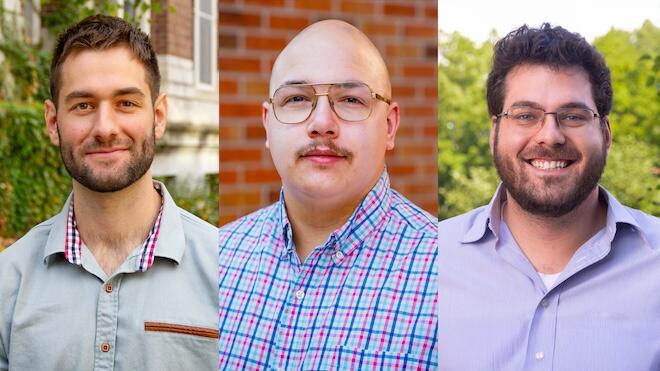
BRISTOL, R.I. – Doctoral success is often associated with early specialization, but the experiences of three Roger Williams University alumni suggest another route: one rooted in academic breadth, collaborative research, and meaningful faculty relationships. Through Applied Mathematics combined with complementary disciplines, each alum built a foundation that carried them well beyond their undergraduate years.
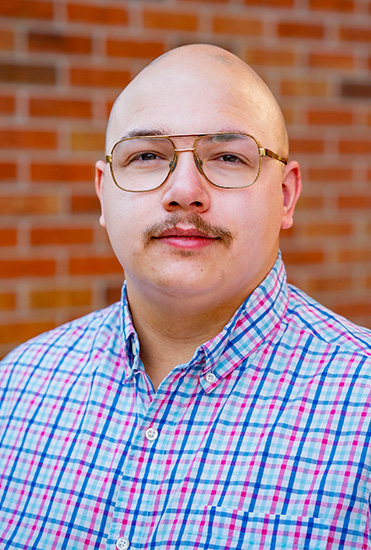
One such alum is Matthew D’Amico ’20, who began his academic journey at RWU as a transfer student. A turning point came during a Differential Equations course taught by Professor of Mathematics Yanji Warnapala, which prompted D’Amico to add a major in Applied Mathematics alongside minors in Physics and Environmental Science.
D’Amico soon turned to Warnapala for guidance beyond the classroom. She served as both his academic advisor and research mentor, supporting him throughout the remainder of his undergraduate career. That mentorship extended well beyond course planning, becoming a defining element of his academic experience.
D’Amico said the individualized attention he received from faculty at RWU played a critical role in shaping his path forward. “I got a lot of attention when I had questions or wanted to dive deeper,” he said. “The professors took research very seriously, and that had a huge impact on the way I approached my future work.”
Under Warnapala’s advisement, D’Amico completed a senior thesis that later evolved into his doctoral research. He went on to earn his Ph.D. at the University of New Hampshire, focusing on the same topic, and is now an Assistant Professor of Mathematics at Colorado Mesa University. He is one of three Applied Mathematics alumni from RWU to have earned a doctoral degree.
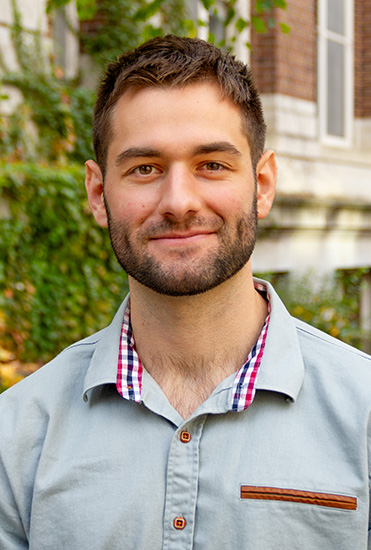
Another alumnus, Tyler Simmons ’19, discovered the Applied Mathematics program toward the end of his first year at RWU and paired it with his Marine Biology major. He found that the two disciplines complemented one another, particularly when applying mathematical modeling and analytical thinking to biological systems. Simmons later added a Physics minor, further strengthening his interdisciplinary approach.
Simmons’ engagement with Applied Mathematics deepened through undergraduate research, supported in part by Warnapala’s mentorship. He said the experience gave him early exposure to the kind of work he hoped to pursue long-term, including presenting his research to the Rhode Island Department of Health.
“It was extremely valuable,” Simmons said. “It gave me real-world experience and allowed me to collaborate with professionals and present my work in meaningful settings.”
When it came to higher education, Simmons said seminars and personal relationships with his professors greatly influenced his decision to continue his education beyond RWU and receive his doctorate in Biophysics from the University of Maryland. He is now a postdoctoral associate at the University of Minnesota.
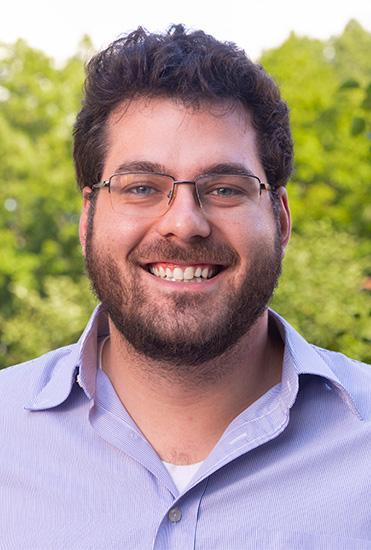
Alumni Andrew DelSanto ’18 took a slightly different path to his doctorate. He studied Mechanical and Electrical Engineering alongside Applied Mathematics, a combination which allowed him to take his academics beyond U.S. borders.
DelSanto served as the President of the RWU chapter of Engineers Without Borders and volunteered with the Foundation for the International Medical Relief for Children – an opportunity that brought him to Ecuador and the Dominican Republic. DelSanto said his experience abroad led him to pursue a career in civil engineering, allowing him to apply his academic skills to help others.
"It's called civil engineering for a reason,” he said, referring to the civilian impact the field has. “It's making buildings, making bridges, trains, and all that stuff which can really change people's lives."
Back in the United States, DelSanto contributed to a range of research projects, including the development of a wearable carbon dioxide sensor designed to detect and map elevated exposure levels. He also worked on a biomathematics research project under former RWU professor Edward Doherty, examining how electrical stimulation in the brains of Alzheimer’s and Parkinson’s patients could temporarily restore memory and mobility.
During the fall of his senior year, DelSanto said he landed a job interview at the corporate headquarters of Clark Construction in Washington, D.C. Following a year in the workforce, DelSanto decided to attend graduate school at the University of Massachusetts Amherst, where he completed both his master’s and PhD.
Now an Assistant Professor of Construction Management at Western New England University, DelSanto credits much of his success to a well-rounded academic and extracurricular background. “They mattered so much more than I ever assumed they would,” he said.
Ultimately, all three alumni credit their success to their involvement at RWU. They urged current students to do the same, whether it be intramural, career fairs, or clubs; each alum articulating the need to build relationships with professors and connect with other students. They found that these relationships gave the critical perspectives needed in their fields to propel them into the successful careers they now hold.