
A More Complex Picture of Rhode Island’s First Couple, Roger and Mary Williams
Roger Williams University History Professor Charlotte Carrington-Farmer talks about her new book about state founder Roger Williams, and a new exhibit about his wife, Mary Williams.
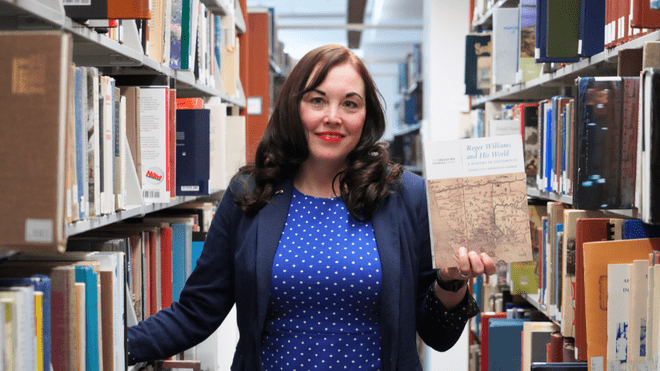
PROVIDENCE, R.I. – If you’ve lived in Rhode Island for any length of time, you’ve heard about Roger Williams. But do we really know what the state’s founder was like?
On the Rhode Island Report podcast, RWU History Professor Charlotte Carrington-Farmer talks about her new book, which uses Williams’s own writings and other primary sources to paint a complex picture of the university’s namesake.
And she discusses a new Rhode Island Historical Society exhibit that provides fresh insights into Williams’s wife, Mary, who has received a fraction of the attention and credit given to her husband.
“I hope with reading these sources yourself, you get a sense of Roger in all of his complexity, with all of those nuances,” Carrington-Farmer said. “And the same for Mary, too. I hope from the book and from the exhibit, you see that she played a really important role.”
In the book, Carrington-Farmer demonstrates that the story of Roger Williams is complicated, filled with contradictions.
“He proclaimed Indigenous People were equal in God’s eyes, but also referred to them as proud and filthy barbarians,” she wrote. “He described how he longed to convert Indigenous Peoples to Christianity, but later changed his mind and declared that forced religious worship was so offensive to God it stunk in His nostrils.”
And while Williams is famous for creating “Rhode Island’s bold experiment in religious freedom for all,” she said he “detested the Quaker religion.”
In the 17th century, Quakers were considered some of the most dangerous people of that time, Carrington-Farmer explained. “We tend to think of Quakers in the 18th and 19th century as being these pacifists,” she said. But they were then challenging the hierarchy of the church and state, and some Quakers “turn up to church naked, protesting established religion by taking their clothes off,” she said.
Williams considered Quakers “clownish,” she said, but he allowed them to practice their religion in Providence “for better or worse.”
The contradictions in Williams are clear, Carrington-Farmer said, when he founds Providence in part on “this ideal of Indigenous land rights,” but later “takes a young Pequot boy as an unfree person in his house.” She said it’s unclear if the boy was enslaved, but Williams later described him as his Native servant.
The book also tells the story of how Roger Williams fell in love with a woman named Jane Whalley before he met Mary. Williams went to Whalley’s aunt, Lady Joan Barrington, and asked for her hand in marriage.
“But he was not of the gentry status, and so she forbids the marriage on that ground, and those letters are cringeworthy,” Carrington-Farmer said. “I’ve included them in my book because I think they really humanize Roger Williams.”
Carrington-Farmer wrote that Roger Williams “is arguably the most written-about person of 17th-century New England,” and the traditional “great man” narrative depicts him as “a lone hero in the grand founding of Providence.” But, she wrote, “none of his accomplishments would have been possible without Mary Williams.”
For example, she noted Roger Williams returned to England twice to secure a royal charter for his colony.
“And it’s Mary who’s left running the show,” Carrington-Farmer said. “Roger, whilst he’s in England in the 1650s, writes these desperate letters begging Mary to join him in England, and she refuses. She’s got a job to do in keeping Providence going.”
Mary Williams’s independent streak was also clear when she continued to participate in services at the Salem Church after her husband stopped attending, and he refused to pray or give thanks at meals with her.
“It must have been awkward, right?” Carrington-Farmer said. “We don’t have Mary’s account of what that was like, but again, it’s these small glimmers of Mary’s agency.”
But telling the story of Mary Williams can be challenging, she said, because there’s only one surviving copy of her handwriting — an unsent letter she addressed to “My dear and loving husband.”
Carrington-Farmer curated the exhibit about Mary Williams that will be on display at the John Brown House Museum, in Providence, for the next three years.
“It is the first public history display telling the important and overlooked role of Mary in the founding of Providence and later Rhode Island,” she said.
The Rhode Island Report podcast is produced by The Boston Globe Rhode Island in collaboration with Roger Williams University. To get the latest episode each week, follow the Rhode Island Report podcast on Apple Podcasts, Spotify, and other podcasting platforms, or listen in the player above. You can sign up for 30 days of free unlimited access to Globe.com here.