
Where Human Expertise Meets Artificial Intelligence: How Roger Williams University Prepares Students for an AI-Driven Future
Faculty and staff explore a values-driven approach to AI literacy that enhances creativity, reduces bias, and empowers tomorrow’s workforce.
BRISTOL, R.I. – As artificial intelligence becomes more prominent in daily life and professional practice, Roger Williams University is looking ahead – examining how to prepare students to engage with AI thoughtfully, ethically, and creatively as they enter the workforce.
On Nov. 19, faculty, staff, and administrators came together for the AI Symposium: Research and Teaching at RWU, a campuswide conversation exploring how AI intersects with teaching, learning, and research across disciplines. The symposium highlighted a shared theme: while AI tools continue to evolve, human expertise remains central to meaningful education.
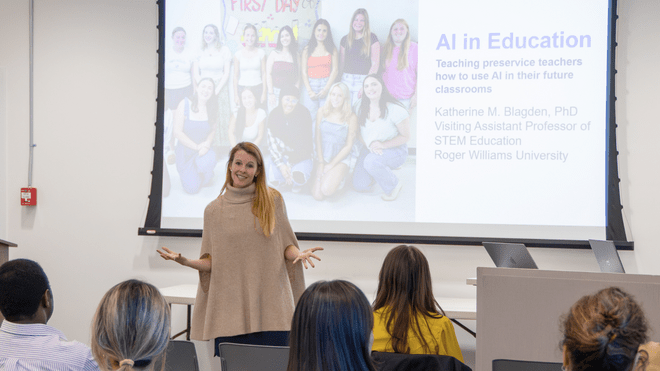
“The most powerful technology in the classroom isn’t AI,” said Visiting Assistant Professor of STEM Education Katherine Blagden. “It’s the teacher who knows how to use it.”
That emphasis on human judgment and values was echoed throughout the day. Haley Lott, Research and Student Engagement Librarian, framed AI literacy as a foundational skill that must extend beyond familiarity with specific tools.
“AI literacy cannot be tool-based instruction,” Lott said. “If our definition depends on learning specific platforms, the literacy expires the moment the tool does.”
Instead, Lott advocated for a balanced, values-driven approach that empowers faculty to teach AI literacy in ways consistent with their disciplines and comfort levels. She emphasized that meaningful engagement with AI can occur regardless of how – or whether – it is actively used in the classroom.
“Faculty can teach AI literacy whether you integrate AI heavily, lightly, or not at all,” she said. “Even if you have ethical objections to AI, and even if you don’t feel technically confident.”
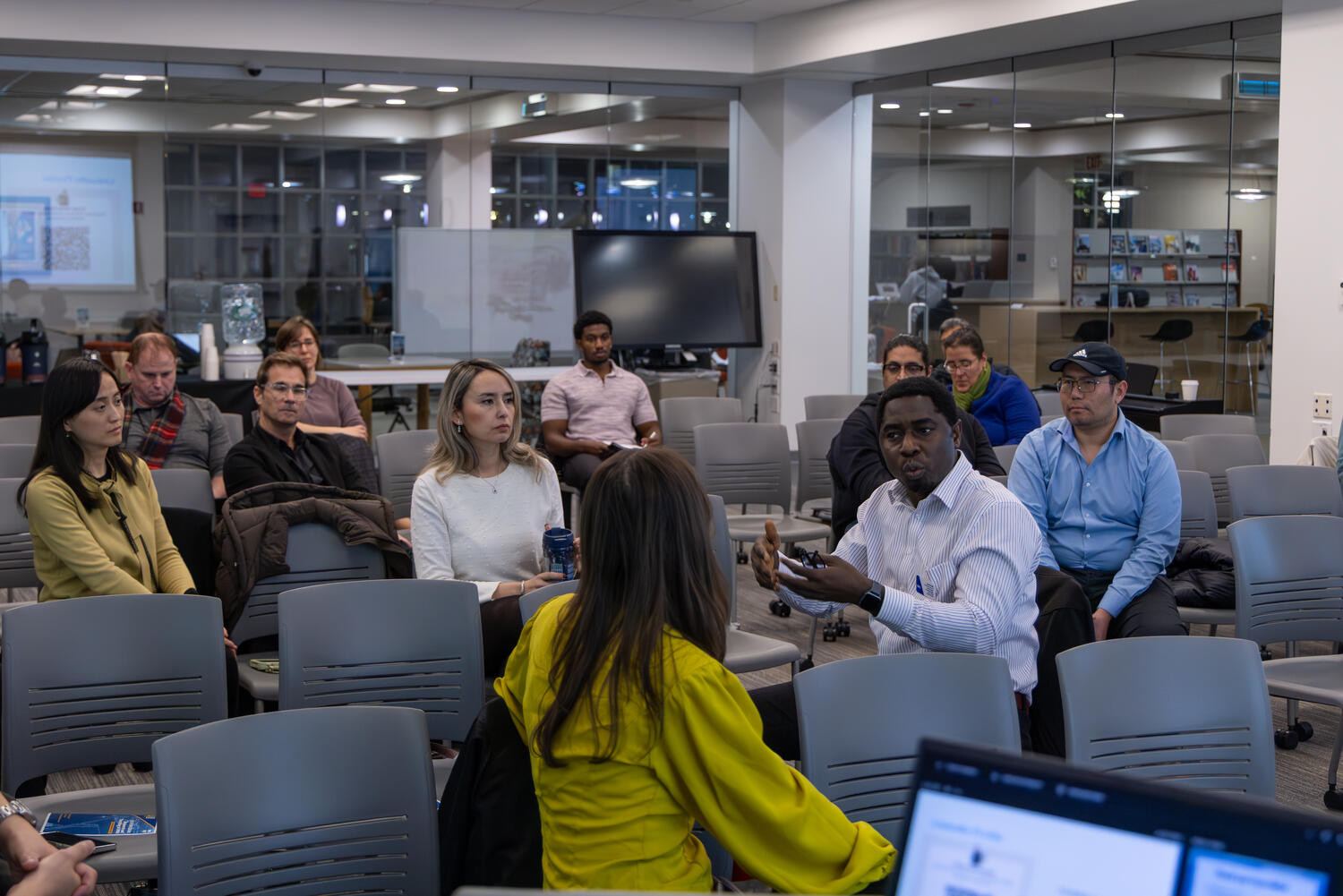
Several presentations addressed the risks of bias often associated with artificial intelligence. Associate Law Professor Natalia Friedlander demonstrated how AI can perpetuate systemic inequity through the data being fed into its processing system. She called for stronger human oversight as AI tools become more integrated into legal practice.
Concerns that AI may diminish human creativity were also challenged during the symposium. Architecture Professor Rubén Alcolea shared how AI is being used as a collaborative tool in design education.
In his courses, students experiment with AI platforms such as DALL-E and PromeAI to generate early concepts, which then serve as starting points for deeper creative exploration. “The AI images were used as seeds to enhance the creative process while moving from digital to purely physical,” Alcolea said.
Across disciplines, the symposium underscored a common goal: equipping students with the critical thinking, ethical awareness, and adaptability needed to navigate an AI-driven future.
As AI literacy continues to take shape across RWU’s curriculum, it is helping Hawks develop the professional skills and human perspective needed to soar even higher into their futures.