
RWU Professor Receives Grant to Strengthen Rhode Island’s STEM Workforce
Biology Professor Avelina Espinosa will implement a training program that introduces high school students to electrochemical genosensing while training college students for biotechnology career pathways in the Ocean State.
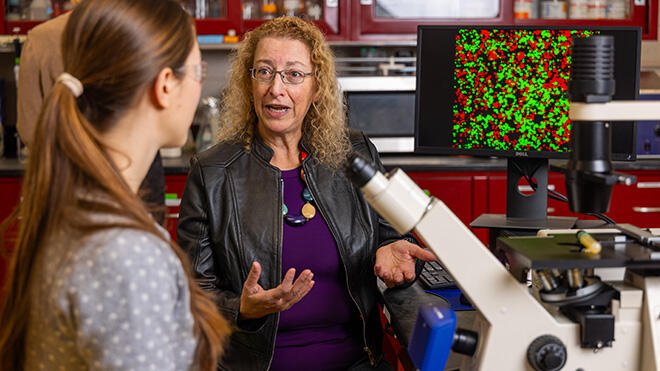
BRISTOL, R.I. – Roger Williams University is taking a collaborative approach to building a stronger STEM community within the Ocean State. RWU Professor of Biology Avelina Espinosa is leading an interdisciplinary team of faculty, high school teachers, and college and high school students to launch an immersive biotechnology training program designed to inspire the next generation of STEM leaders to build careers in Rhode Island.
Supported by a National Science Foundation (NSF) Rhode Island Network for Excellence in Science and Technology (RI-NEST) Seed Grant Award, Espinosa will lead a 12-day program in summer 2026 that combines virtual instruction with hands-on laboratory experience. The initiative brings together RWU faculty, high school teachers, college and high school students, and a science visualizer to introduce participants to electrochemical genosensing – an emerging biotechnology technique used to detect pathogens.
“The electrochemical genosensor project could be an ideal biotechnology training path not only for high schools, but for community science education programs across Rhode Island,” said Espinosa.
High school students and their teachers will participate in a 10-day virtual training segment led by faculty and undergraduate mentor teams. The virtual component, designed by Ellen Fritz, a science visualizer who spent time with NASA, will feature custom simulations and instructional materials designed to make complex laboratory techniques accessible and engaging.
The program concludes with a two-day, on-campus experience featuring hands-on electrochemical genosensing lab work. High school teams will receive a demonstration on how to assemble a genosensor and test it, then work alongside RWU faculty and undergraduate mentors to build and evaluate a prototype biosensor.
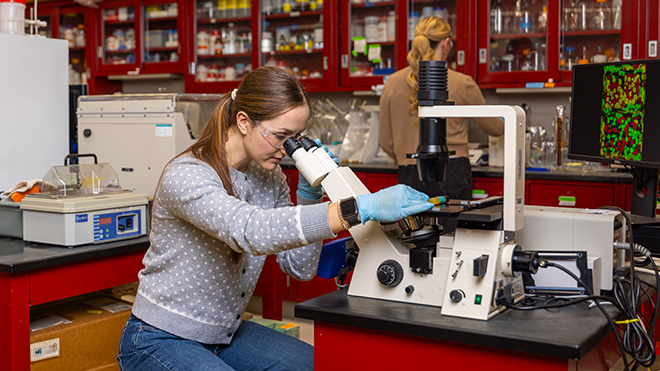
The interdisciplinary project integrates molecular biology, physics, and electrical engineering. Associate Professor of Physics Jennifer Pearce will guide nanoparticle platform design training, while Assistant Professor of Electrical Engineering Allison Marn will lead electrochemical detection design instruction.
The Espinosa, Pearce, and Marn collaboration focuses on developing a portable, field-ready biosensor capable of detecting parasitic protists, which trigger harmful algal blooms (HABs), a threat to marine ecosystems, public health, and fisheries. The device uses a bioengineered strand of DNA combined with gold nanoparticles and methylene blue. When environmental DNA binds to the engineered strand, a measurable voltage change occurs, signaling the presence of contamination. The compact design allows for on-site testing, reducing reliance on time-intensive laboratory analysis.
“The intention of a biosensor is that it’s portable, you can go to the field, put it in the water, and if something is there that is contaminated, this will bind.”
NSF-RI-NEST’s Seed Grant program supports faculty and student research across Rhode Island institutions. This year, seven projects were selected statewide, including Espinosa’s proposal to expand biotechnology training and research capacity.
By connecting education, research, and workforce development, the initiative aligns with Rhode Island’s growing Blue Economy and reinforces Roger Williams University’s commitment to preparing students for impactful careers in science and technology.